URL Shortener for SaaS Companies: The Complete 2026 Guide
A SaaS company's link infrastructure is not a marketing accessory — it is product and growth plumbing. Every email in a lifecycle sequence has a CTA link whose click performance determines whether the email is doing its job. Every in-app contextual prompt to upgrade, learn about a feature, or invite a colleague includes a link whose destination and tracking architecture are engineering decisions, not marketing afterthoughts. Every share link that allows a user to send a specific product view to a colleague is a product feature with measurable virality impact. Every channel that drives free trial signups needs a short link with independent tracking to attribute Trial-to-Paid conversions accurately. The SaaS company that treats link management as a cross-cutting infrastructure concern — integrating it into the product, the growth stack, and the marketing automation — extracts more signal from its link analytics and presents a more consistent professional identity in every touchpoint than the one that creates short links ad hoc in a dashboard when someone remembers to. This guide covers the complete link management picture for SaaS companies: the architecture decisions, the product integration patterns, the marketing use cases, the API implementation, and the analytics framework that ties attribution from first click through to paid conversion.
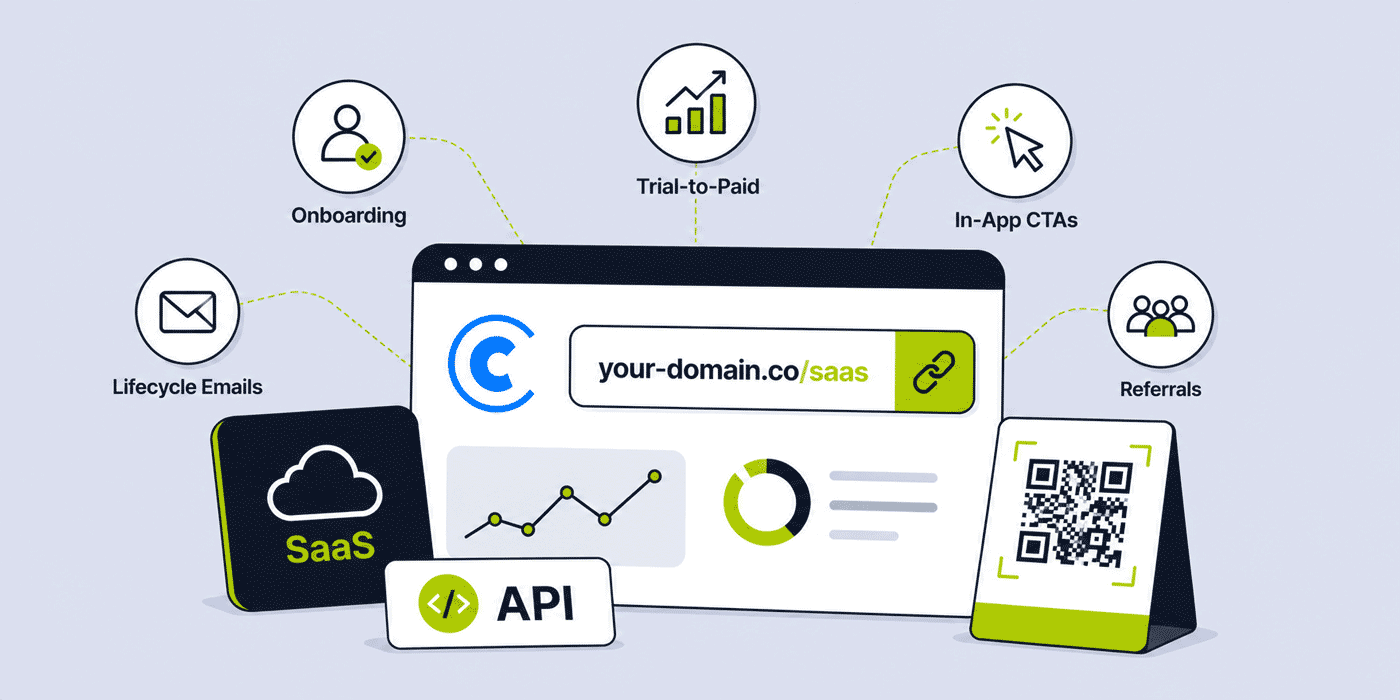
What This Guide Covers
- Why branded domains are a product and trust standard for SaaS, not a marketing preference
- The SaaS link taxonomy: where short links appear in a SaaS company's stack
- Trial-to-Paid attribution: channel tracking from first click to paid subscription
- Onboarding link architecture: activation emails and deep links
- Product-Led Growth: share links, referral mechanics, and virality tracking
- In-app CTAs and contextual upgrade prompts
- Lifecycle email campaigns: per-email, per-CTA link tracking
- Content marketing: tracked links for SEO content and distribution
- Partnership and integration directory links
- API integration: programmatic link generation in the SaaS stack
- Team API for organisational link management
- Analytics architecture: Cuttly + UTM + product analytics three-layer model
- Deep links to specific product features
- SaaS billing and plan upgrade links
- Customer success and support link management
- Which Cuttly plan suits a SaaS company's stage and scale
Why Branded Domains Are a Product Standard for SaaS
A SaaS product's brand is built through every touchpoint its users and prospects encounter. The quality of the UI, the speed of the application, the clarity of support documentation, the tone of lifecycle emails, and the professionalism of every link in every communication — all contribute to the user's cumulative perception of the product's quality and trustworthiness.
A branded short link on the SaaS company's own domain — go.yourproduct.com/upgrade, links.yourproduct.com/onboard — is a product-level standard consistent with the care that goes into the product itself. A generic shortener domain link in a transactional email (cutt.ly/aBcDeF or any other generic domain) is a brand inconsistency that undercuts the professional identity the product otherwise projects.
The trust dimension is commercially relevant: SaaS lifecycle emails — particularly upgrade prompts, payment renewal reminders, and plan expiry notifications — are contexts where users are alert to the quality and authenticity of communications. A user who receives a payment renewal email with a link on an unfamiliar generic domain will apply more scrutiny to whether the email is genuine. A link on the product's own domain resolves that scrutiny immediately. In contexts where phishing of SaaS platforms is documented, the branded domain is a meaningful trust signal.
For SaaS companies that embed links in the product interface itself — contextual upgrade prompts, help documentation links, feature announcement banners — branded short links on the product's domain are part of the product's UX layer. A contextual upgrade CTA that routes through a branded short link provides click analytics on that specific in-app prompt, giving the product team data on which in-app upgrade surfaces are performing and which are being ignored.
The SaaS Link Taxonomy: Where Short Links Appear in the Stack
Before diving into individual use cases, a taxonomy of where short links appear in a SaaS company's operations clarifies the full scope of the link management challenge:
Acquisition layer: links in paid search ads, content marketing articles, social media posts, podcast sponsorships, partnership placements, and app store listings. These links drive traffic to the website and trial signup page. Per-channel tracking at this layer feeds Trial-to-Paid attribution.
Conversion layer: links on the pricing page, upgrade CTAs, trial-to-paid conversion emails, and plan comparison pages. These links drive the transition from free or trial status to paying subscriber. Click analytics at this layer reveal which conversion surfaces are generating the most upgrade intent.
Onboarding layer: links in welcome emails, activation emails, onboarding checklists, tutorial completion prompts, and in-app first-run experiences. These links drive activation — the critical metric in SaaS onboarding where the user reaches the "Aha moment" and establishes habitual product use.
Retention and expansion layer: links in product newsletters, new feature announcement emails, monthly usage reports, success milestone emails, and expansion CTA prompts (upsell to higher plans, cross-sell to complementary products). These links drive retention and net revenue retention.
Virality and referral layer: share links in the product that allow users to distribute specific content or product views to colleagues, referral links in referral programmes, and partner co-marketing links. These links are often generated programmatically at scale.
Support and success layer: links in support documentation, customer success check-in emails, help centre articles, and status page notifications. These links reduce friction in the support experience and drive self-service resolution.
Each layer has different link management requirements, different analytics needs, and different API integration considerations. A mature SaaS company manages all of them systematically; an early-stage company may focus on the acquisition and conversion layers first and build out the others progressively.
Trial-to-Paid Attribution: From First Click to Paid Subscription
Trial-to-Paid attribution is the measurement of which marketing channels and activities are actually driving paid subscribers — not just which drive trial signups. A SaaS company that can see that Channel A (content marketing) drives 40% of trial signups but only 15% of paid conversions, while Channel B (LinkedIn Ads) drives 20% of trial signups but 35% of paid conversions, has information that fundamentally changes its CAC (Customer Acquisition Cost) calculation and budget allocation. Without this attribution, channel ROI is invisible.
The mechanism: create a unique branded short link per marketing channel, all routing to the same trial signup page. Add UTM parameters to each link: utm_source=linkedin-ads, utm_medium=paid-social, utm_campaign=q3-trial-2026. The short link click (from Cuttly analytics) shows who clicked per channel. The UTM parameters (captured in the product's analytics or the signup form) attribute the trial signup to the originating channel. If the billing system captures UTM parameters at subscription creation (via the signup URL's UTM parameters passed through the trial period), the paid conversion is also attributed.
The three-layer attribution model: Cuttly analytics shows clicks per channel link (marketing engagement); product analytics (Mixpanel, Amplitude, Heap) shows trial signups per UTM source (acquisition conversion); billing system or CRM (Stripe, Chargebee, HubSpot) shows paid conversions per originating UTM source (commercial conversion). The combined picture: click → trial → paid, attributed per channel.
Why Cuttly analytics adds value beyond UTM alone: UTM parameters only capture click attribution when the signup page is reached — they miss the click volume from visitors who bounced before signing up, or who arrived at the signup page from a link but converted days later in a new session (losing UTM attribution). Cuttly's link analytics records every click on the channel link, including those that did not result in an immediate signup — showing the full funnel from channel exposure to signup attempt.
Onboarding Link Architecture
SaaS onboarding is the most commercially critical period in a customer's lifecycle — the window between signup and the moment the user establishes habitual value from the product. Research consistently shows that users who reach the product's activation moment (a specific action that correlates with long-term retention) within the first few days are dramatically more likely to remain paying customers. Every link in the onboarding sequence that directs users toward activation actions is a commercial asset worth measuring.
A well-architected onboarding link set: each email in the onboarding sequence has a unique tracked short link for its primary CTA. Email 1 (welcome + setup CTA): go.yourproduct.com/onboard-e1-setup. Email 2 (first feature prompt): go.yourproduct.com/onboard-e2-feature1. Email 3 (activation milestone): go.yourproduct.com/onboard-e3-activate. All tagged with campaign-onboarding-2026 for Campaigns aggregation.
Analytics on onboarding links reveal: which email in the sequence generates the most CTA engagement (activation intent), at what point in the sequence click rates drop (where users are disengaging), and whether mobile or desktop users engage differently with specific onboarding CTAs. This data feeds onboarding email optimisation — with each change to an email's CTA creating an A/B test opportunity using Cuttly's link rotation feature.
For deep linking in onboarding — CTA links that route users not to the product's homepage but to a specific in-app location or pre-populated feature — Cuttly's deep link capabilities (available from the Single plan for mobile URL/deep link ready, Team plan for full deep linking with App Store/Play Store routing) allow onboarding email CTAs to open the product at the specific step the email is promoting, rather than requiring the user to navigate from the homepage. A 30-second reduction in time-to-value in the onboarding flow is commercially meaningful at scale.
Product-Led Growth: Share Links, Referral Mechanics, and Virality Tracking
Product-Led Growth (PLG) in SaaS uses the product itself as the primary acquisition channel — viral loops built into the product that generate new users from existing users' activity. Short links are embedded in two primary PLG mechanisms: share links (users sharing specific product outputs or workspaces with colleagues) and referral links (users deliberately inviting others through a referral programme).
Share Links
When a user wants to share a specific product output — a document, a dashboard, a report, a workspace view — they need a shareable URL. In most SaaS products, this URL is either a long internal URL or a public view URL generated by the product. A branded short link wrapping this share URL provides: a cleaner share experience (the recipient sees a link on the product's domain, not a long internal URL), click analytics (how many recipients actually opened the shared link — a virality metric), and dynamic destination capability (if the shared content's URL changes, the short link destination is updated).
For SaaS products that generate share links programmatically at scale — a project management tool where every shared project has a unique URL, a collaborative document tool where every shared document has a share link — API-based short link creation is the architecture. The share link generation endpoint in the product's backend calls the Cuttly API, creates a branded short link with a project/document-specific alias, and returns the branded short URL for display in the share dialog. The product user sees a clean branded link; the product team sees click analytics on which shared content is generating engagement.
Referral Programmes
A referral programme gives each user a unique referral link — clicking the link and signing up for a trial credits the referring user with a reward (account credit, extended trial for the referred user, a feature unlock). The referral link must be: unique per referring user (so credit attribution is accurate), on the product's branded domain (trust signal for the referred user, who often receives it via personal email or message), and tracked with click analytics (to see how many people each referrer is sending, and how many of those click-through).
Implementation with Cuttly API: at the time of referral programme signup (or dynamically when a user requests their referral link), the product's backend creates a branded short link via the API with a user-specific alias (go.yourproduct.com/ref-user12345). The link routes to the trial signup page with a ref=user12345 query parameter that the signup system uses for credit attribution. Cuttly analytics tracks total clicks per referral link; the product's conversion analytics track which referral clicks converted to signups.
Aggregate referral programme analytics: with all referral links tagged campaign-referral-2026 in Cuttly, the Campaigns view shows total referral link engagement across all referring users — a high-level virality measurement. The click data from Cuttly combined with signup data from the product shows the referral programme's overall conversion rate (clicks → signups) and identifies the highest-referring users (whose referral links generate the most clicks and conversions).
In-App CTAs and Contextual Upgrade Prompts
In-app contextual CTAs — upgrade banners, feature gate prompts, usage limit notifications, plan comparison tooltips — are among the most commercially valuable surfaces in a SaaS product. A user who encounters a feature gate in the middle of active product use and is prompted to upgrade is at a high-intent moment. The click analytics on in-app upgrade CTA links reveal which specific prompts are generating the most upgrade intent.
Each distinct in-app CTA should have its own tracked short link: the upgrade banner at the top of the dashboard (go.yourproduct.com/upgrade-banner), the feature gate modal on Feature X (go.yourproduct.com/upgrade-feature-x), the usage limit notification (go.yourproduct.com/upgrade-limit), the monthly recap email upgrade prompt (go.yourproduct.com/upgrade-recap). All route to the pricing or upgrade page; each generates independent analytics.
The analytics question this structure answers: which in-app surface is generating the most upgrade CTR? If the feature gate prompt for Feature X generates 5× the upgrade page visits of the usage limit notification, Feature X is the highest-intent upgrade trigger for the product's user base. Product decisions — prioritising expansion of Feature X, improving the feature gate messaging, or redesigning the usage limit notification — are informed by this specific data.
Combined with Cuttly's A/B link rotation (Single plan: 50/50 split; Team plan: configurable split), each in-app CTA can run a concurrent A/B test on the destination — routing half of clicks to pricing page version A and half to version B. The A/B test results, combined with conversion data from the product's analytics, identify which pricing page version converts upgrade intent into upgrade action more effectively.
Lifecycle Email Campaigns: Per-Email, Per-CTA Link Tracking
Lifecycle emails — welcome, activation prompts, feature announcements, usage milestones, renewal reminders, re-engagement sequences — are the most directly measurable communication a SaaS company sends. Every email has a purpose (drive a specific action), a CTA link (the mechanism for that action), and a success metric (the proportion of recipients who click and complete the intended action). Per-email, per-CTA tracked short links make this measurement precise.
Most ESP platforms (Mailchimp, Klaviyo, Customer.io, Intercom, HubSpot, Braze, Iterable) provide their own link click tracking — but typically at the campaign aggregate level, not at the individual link level with the enriched analytics (geographic, device, time-of-day) that Cuttly provides. Using Cuttly short links in lifecycle emails provides: per-link click analytics independent of the ESP, bot-filtered click counts (security scanners that pre-click all links in corporate inboxes), and a long-form historical record (1 year on Single plan, 2 years on Team) that allows year-over-year lifecycle email performance comparison.
The bot click issue is particularly relevant for SaaS lifecycle emails: SaaS products disproportionately serve corporate users with enterprise email security solutions (Proofpoint, Mimecast, Microsoft Defender) that pre-click every link in incoming emails. This inflates raw click counts in ESP analytics. Cuttly's automatic bot filtering (available on all plans) removes these pre-click bot events, giving a cleaner picture of genuine human engagement with lifecycle email CTAs. See the email deliverability and tracking guide for the full treatment.
For SaaS lifecycle email optimisation: tag all links in a specific lifecycle email sequence with the sequence name (sequence-trial-onboarding), the email position (email-day3), and the CTA position (cta-primary). Cuttly Campaigns (Team plan) aggregates all links with the same sequence tag, showing total sequence engagement. Per-email filtering shows drop-off points. Per-CTA filtering shows whether secondary CTAs are generating any meaningful additional engagement beyond the primary.
Content Marketing: Tracked Links for SEO Content Distribution
SaaS content marketing — blog posts, case studies, comparison pages, integration guides, documentation, tutorials — generates organic traffic from search and from content distribution channels. The links from content pieces to the trial signup page, to the pricing page, and to other product pages are conversion touchpoints within the content funnel.
A branded short link in the CTA at the end of a high-performing blog post — go.yourproduct.com/try-free-blog — tracks how many blog readers follow through to trial signup. Comparing this across different blog posts reveals which content topics generate the highest reader-to-trial conversion rate (not just the highest traffic volume). A post that generates 2,000 organic visits and 40 trial signup link clicks (2% click rate) is outperforming a post that generates 8,000 visits and 80 trial signup link clicks (1% click rate) in terms of content-to-conversion efficiency.
For content distributed across multiple channels — a blog post shared to LinkedIn, Twitter, email newsletter, and a Slack community — per-channel tracked links show which distribution channel generates the most content engagement and downstream trial intent. The same article's trial signup CTA generates different click rates per distribution channel, informing where to concentrate future content distribution effort.
API Integration: Programmatic Link Generation in the SaaS Stack
For SaaS companies that generate links programmatically — share links, referral links, personalised onboarding URLs, per-user resource links — the Cuttly API is the integration point. The architectural decisions mirror those described in the developer API guide: synchronous vs asynchronous creation, idempotency through deterministic aliases, rate limit management, and graceful degradation.
The SaaS-specific architectural considerations:
Use the Team API, not personal API keys. A SaaS product's link generation infrastructure must use the Team API key (tied to the workspace, not to any individual) rather than a personal key. A personal key that is tied to an engineer's account creates an organisational dependency — when the engineer leaves, the integration breaks. The Team API key persists as long as the workspace exists. See the Team API vs Personal API architectural differences guide.
Deterministic aliases for idempotency. When the SaaS product creates a short link for a specific entity (a project, a user's referral programme, a specific document), derive the alias from the entity's stable identifier. go.yourproduct.com/share-proj-12345 is derived from project ID 12345 — idempotent. If the same project's share link is requested twice (due to a webhook retry or a duplicate API call), the second request receives a status 4 (alias conflict) response, which the integration treats as success — the link already exists. This prevents duplicate links for the same entity.
Asynchronous creation for non-blocking performance. Link creation should not block the primary user action that triggers it. When a user shares a project, the primary action (creating the share view) should complete immediately; link creation happens in a background job. The user sees the branded short link within seconds (background job latency), not immediately — an acceptable trade-off for not blocking the primary UX flow.
Environment isolation. Development, staging, and production environments each use separate Cuttly team workspaces (or separate accounts) with separate API keys and separate branded domains (or go.dev.yourproduct.com vs go.yourproduct.com). This prevents dev and staging link creation from consuming production link quotas or polluting production analytics.
Team API for Organisational Link Management
Beyond product-embedded link generation, the SaaS company's marketing, content, sales, and customer success teams all create and manage short links for their respective activities. Without a shared workspace and governance model, link creation becomes fragmented — inconsistent naming conventions, missing UTM parameters, mixed branded and generic domains, and untagged links that cannot be aggregated into campaign analytics.
The Team plan workspace provides the shared infrastructure: all team members create links within the shared workspace, on the company's branded domain, following the documented naming convention, with the campaign tags applied at creation time. The marketing team's lifecycle email links, the sales team's prospect-specific landing page links, the content team's blog post CTA links, and the customer success team's onboarding resource links are all in the same workspace, searchable, filterable by tag, and aggregatable via Cuttly Campaigns.
Role-based access (Owner, Admin, Moderator, User, Viewer) controls who can create links, who can manage workspace settings, and who can access the Team API key. Engineers who build the product integration use the Team API key, which they access as a secured environment variable — they never need dashboard access. Marketers who create campaign links use User role — they can create and manage links but cannot modify team settings or access the API key. Leadership who needs analytics visibility uses Viewer role.
Analytics Architecture: Three-Layer Attribution Model
The mature SaaS link analytics architecture has three layers that together provide complete attribution from marketing channel to paid conversion:
Layer 1 — Cuttly click analytics: total clicks per link (bot-filtered), unique clicks, click timing, device, OS, geographic distribution, referrer. This layer answers: who clicked, when, on which device, from where. Provides channel engagement data before the user arrives at the product.
Layer 2 — Product analytics via UTM (Mixpanel, Amplitude, Heap, or similar): sessions attributed to UTM sources, activation events per source, feature adoption per source, upgrade events per source. This layer answers: what did users from each channel do in the product? Which channels drive users who activate, and which drive users who churn? Provides in-product behaviour attribution.
Layer 3 — Revenue analytics via billing system (Stripe, Chargebee, or CRM): Trial-to-Paid conversion rate per UTM source, MRR attributed per acquisition channel, LTV by channel. This layer answers: which channels drive revenue, not just signups? Provides commercial attribution.
The connection between layers: Cuttly short links carry UTM parameters to the product signup page, where the product's analytics SDK captures the UTM values. The UTM source is stored in the user's profile in the product database. When the user converts to a paid subscription, the billing system or CRM captures the originating UTM source (via the user's profile) and attributes the payment to the channel. The chain is: Cuttly click → UTM captured at signup → UTM followed through product analytics → UTM attributed to payment event.
This three-layer model is the standard architecture for data-driven SaaS growth. Cuttly's role is Layer 1: the click-level engagement data and channel-level traffic measurement that feeds the overall attribution model.
Deep Links to Specific Product Features
Deep linking — routing a user from an external link directly to a specific in-app location — is a UX improvement for SaaS products that reduces time-to-value in onboarding and lifecycle email flows. A new user who clicks an onboarding email CTA and is taken to the specific setup step the email was promoting, rather than the generic dashboard homepage, has a meaningfully better activation experience.
Cuttly's deep link capabilities (mobile URL / deep link ready from Single plan; full iOS and Android deep linking with App Store/Play Store routing from Team plan) support SaaS products with mobile applications or mobile-first web experiences. For web-only SaaS products, deep linking is achieved through URL routing — the short link destination URL includes the specific in-app path that the user should land at.
For mobile SaaS apps specifically, the Team plan's full deep linking routes users who click from a lifecycle email or marketing campaign to: the specific in-app screen if the app is installed; the appropriate App Store or Play Store listing if the app is not installed (deferred deep linking); or the web version if app installation cannot be detected. This ensures that every lifecycle email CTA, regardless of whether the recipient is a mobile app user or a web user, delivers the optimal experience.
Customer Success and Support Link Management
Customer success and support teams generate significant volumes of links in their day-to-day work: links to specific help centre articles, links to account-specific configuration pages, links to status page updates, links to onboarding call booking pages, and links to feature-specific documentation.
Professional branded short links in customer success communications — particularly in email threads and chat conversations with customers — maintain the product's professional presentation in the support experience. A customer success manager who sends a customer a branded short link to a relevant help article (go.yourproduct.com/help-integration-setup) rather than a raw help centre URL is presenting consistently with the product's overall quality standard.
Analytics on support links reveal which help articles are actually being accessed by customers who receive them in support contexts — a proxy for which support communications are effectively self-serving resolution versus which require follow-up. A help article link that generates a 70% click rate in support emails is being used; one that generates 5% may not be the right resource for the context in which it is shared, or the support communication surrounding it may not be compelling the customer to click.
Password-protected short links (Single plan+) have a specific use case in customer success: secure links to account-specific reports, usage dashboards, or configuration documents that contain sensitive account data and should not be publicly accessible. The branded short link on the product's domain presents professionally; the password (communicated separately by the CSM) adds a lightweight access control layer for sensitive account materials.
SaaS Billing and Plan Upgrade Links
Billing-related links — upgrade plan links, payment method update links, invoice access links, subscription management links — are among the highest-sensitivity communications a SaaS company sends. They arrive in contexts (billing reminders, payment failures, plan expiry notifications) where the user is already in a functional relationship with the product and may be experiencing friction.
In these billing contexts, the branded domain is critically important. A payment method update email with a link on the product's own domain — go.yourproduct.com/update-payment — is clearly from the product. A payment method update email with a generic shortener domain link is ambiguous and may be dismissed or reported as phishing by security-conscious users. Given that payment method update emails are one of the most commonly impersonated SaaS communication types in phishing attacks, the branded domain difference is genuinely commercially significant — it reduces the friction of users acting on billing communications.
Analytics on billing email links — how many users who receive a payment failure notification actually click the payment update link, and how quickly — provide a payment recovery funnel metric that most SaaS companies track without realising link-level analytics can improve its measurement precision.
Partnership and Integration Directory Links
SaaS products participate in integration directories, partner marketplaces, and technology alliance ecosystems — Salesforce AppExchange, HubSpot App Marketplace, Zapier, Make, Slack App Directory, and many others. The links from these partner placements to the SaaS product's signup or integration page are significant acquisition channels for products with established marketplace presence.
Each marketplace listing should use a unique tracked short link — go.yourproduct.com/integrate-salesforce, go.yourproduct.com/integrate-zapier, go.yourproduct.com/marketplace-hubspot. Analytics per integration directory show which ecosystems are generating the most qualified traffic. A SaaS product that receives 400 website visits per month from its Zapier listing and 30 from its HubSpot listing has data to inform where to invest in deeper integration development and marketplace promotion.
Which Cuttly Plan Suits a SaaS Company
The right Cuttly plan for a SaaS company depends on stage, scale, and whether product-level API integration is in scope.
The Free plan ($0) covers initial setup: 30 links/month, 1 branded domain, basic analytics (30 days), UTM builder. Appropriate for pre-launch or very early-stage products establishing basic link infrastructure. The 30-link monthly limit and 30-day analytics window quickly become limiting for any active marketing activity.
The Single plan ($25/month) is the practical starting point for most active SaaS companies. 5,000 links/month, 1 year of analytics history for Trial-to-Paid attribution across campaign cycles, up to 5 branded domains (useful for product-specific vs marketing-specific domain separation), full QR customization, A/B link rotation (50/50 split) for lifecycle email CTA optimisation, deep link ready for mobile URLs, password-protected links for account-sensitive documents, and API access at 60 calls/60s with 1,000 branded domain links/month.
The Team plan ($99/month) is appropriate for SaaS companies with active product-level API integration, or with marketing and product teams both creating links systematically. Key differentiators over Single: Team API key (required for production API integration — the architectural reason is described in the developer guide), A/B test with configurable percentage splits (not just 50/50) for more nuanced lifecycle email CTA testing, full deep linking with App Store/Play Store routing for mobile app CTAs, 20,000 links/month, 2 years of analytics history for longer-term channel attribution analysis, and Cuttly Campaigns for aggregate lifecycle email and growth campaign analytics.
The Enterprise plan ($149/month) is appropriate for high-scale SaaS operations with extensive API link generation (50,000 links/month, 360 API calls/60s), A/B/C three-variant link testing, and SSO for team access management.
Start with Cuttly's free plan to set up your branded domain and establish the link infrastructure foundation — no credit card required. Upgrade to Single or Team when the API integration, analytics depth, or link volume requires it. Registration required; free plan available immediately.
Frequently Asked Questions
Why do SaaS companies need a URL shortener?
Three reasons: branded domain consistency in every product and marketing communication (trust signal particularly important in billing and lifecycle emails), Trial-to-Paid attribution through per-channel tracked links combined with UTM parameters, and scalable programmatic link generation via API for share links, referral mechanics, and personalised onboarding URLs.
How do SaaS companies use short links in PLG?
Share links (branded, generated via API, with click analytics measuring virality), referral programme links (unique per user, tracked for click-to-signup conversion), and in-app upgrade prompts (each prompt has its own tracked link showing which surfaces generate the most upgrade intent).
What is Trial-to-Paid attribution with short links?
Unique tracked short links per acquisition channel (paid search, content, LinkedIn, podcast) all routing to the same trial signup page with UTM parameters. Cuttly tracks clicks per channel; UTM attribution in the product analytics tracks signups; billing system attribution tracks paid conversions. Combined: full click → trial → paid attribution per channel.
- Tools
- URL Shortener →
- Link Analytics →
- Branded Domains →
- Related Guides
- URL Shortener for SaaS 2026 →
- URL Shortener for Startups →
- Developer API Architecture →
- API Developer Guide 2026 →
- Team API vs Personal API →
- Short Links Email Deliverability →
- A/B Test Links Guide →
- Link Tracking 101 →
- UTM Strategy Guide →
- Branded Short Links Guide →
- URL Shortener Security →
- API Documentation
- Team API Reference →
- Start Here
- Create Free Account
- Plans & Pricing
URL Shortener
Cuttly simplifies link management by offering a user-friendly URL shortener that includes branded short links. Boost your brand’s growth with short, memorable, and engaging links, while seamlessly managing and tracking your links using Cuttly's versatile platform. Generate branded short links, create customizable QR codes, build link-in-bio pages, and run interactive surveys—all in one place.
Cuttly - Consistently Rated
Among Top URL Shorteners
Cuttly isn’t just another URL shortener. Our platform is trusted and recognized by top industry players like G2 and SaaSworthy. We're proud to be consistently rated as a High Performer in URL Shortening and Link Management, ensuring that our users get reliable, innovative, and high-performing tools.


