URL Shortener for Night Clubs and Bars: The Complete Guide
The nightclub and bar industry operates at a pace and with a marketing urgency that most other hospitality sectors do not experience. Every event is a discrete, deadline-driven product: a Saturday night with a specific DJ, a capacity of 800, a door opening at 11pm, a curfew at 4am, and a marketing window of 5 to 10 days to sell out. The night after that, a different event with a different lineup and a fresh promotional campaign. The week after that, another. This relentless event-by-event rhythm means that marketing effectiveness is measured in days, not months — and the difference between a sold-out night and an unprofitable one can be determined by which promotional channels the venue is measuring and optimising. A URL shortener with a venue's own branded domain and per-channel tracked links is not a marginal improvement in a nightclub's marketing infrastructure — it is the mechanism by which the venue learns, over weeks and events, which channels are actually selling tickets and driving reservations versus which channels are generating awareness and engagement that does not convert to revenue.
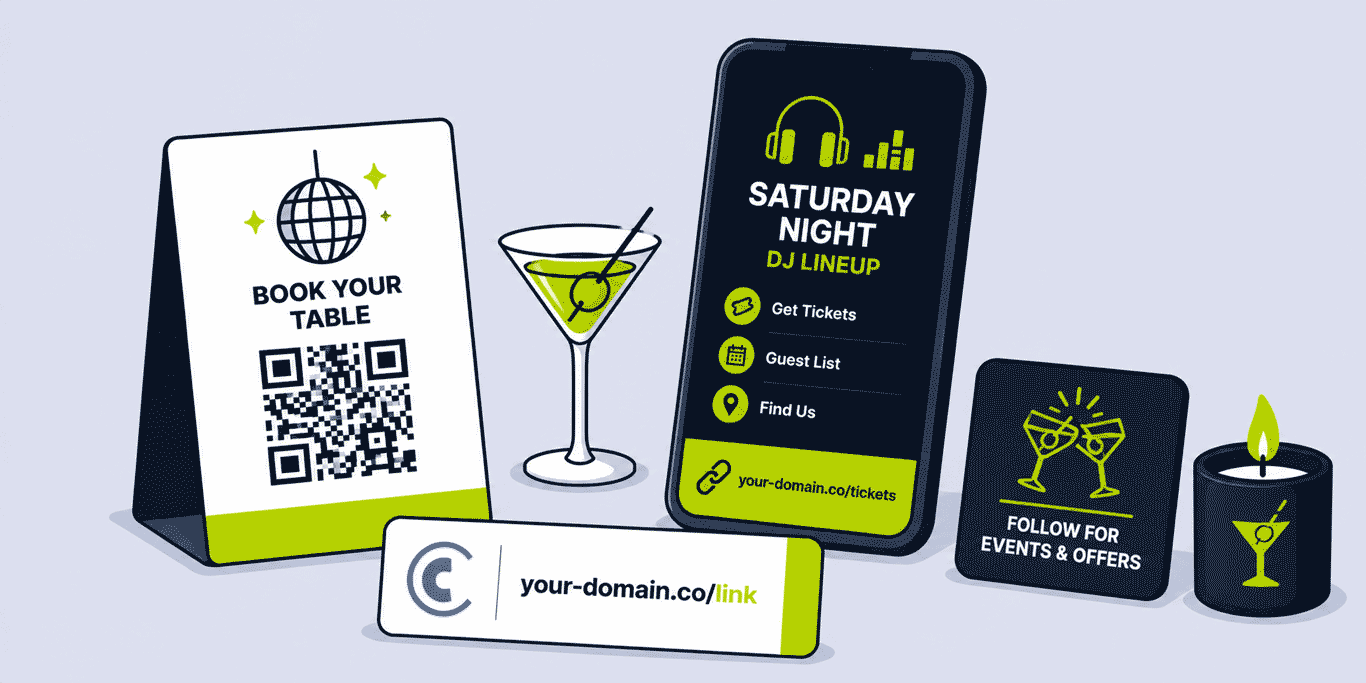
What This Guide Covers
- Event ticket sales: per-channel tracking for every event promotion
- Table reservations: the highest-margin conversion in bar and club revenue
- Guest list management and door list links
- Instagram and TikTok: the dominant discovery channels in nightlife
- DJ and artist announcement links
- WhatsApp broadcast and customer database marketing
- Influencer and promoter partnership tracking
- Flyers and physical promotional materials: QR Codes that track
- In-venue QR Codes: drinks menus, booking, and guest WiFi
- Pre-sale vs door price strategies with tracked links
- Season pass, loyalty, and member communications
- Google Reviews and venue reputation
- Multi-venue and venue group management
- Link in Bio for nightlife social media profiles
- Which Cuttly plan is right for a nightclub or bar
Event Ticket Sales: Per-Channel Tracking for Every Event
For a nightclub or late-night venue that runs ticketed events, the ticket sales page is the most commercially important digital destination it manages. Every promotional activity — every Instagram post, every TikTok video, every WhatsApp broadcast, every flyer, every influencer collaboration — is ultimately in service of driving traffic to that ticket page and converting visitors into paying customers before the event sells out.
Without per-channel tracked links, the venue has no way to know which promotional activities are generating ticket sales versus which are generating social engagement without conversion. An Instagram post with 5,000 views and 400 likes looks successful. But if none of those views converted to ticket page visits, the post generated no revenue — and that information is only available if the Instagram bio link or Story link sticker routes through a tracked short link.
The practical setup for each event: create a set of branded short links per event, one per promotional channel, all routing to the same ticket purchase page. For a Saturday event with a major DJ:
go.venuename.com/event-sat-ig— Instagram bio link (updated per event)go.venuename.com/event-sat-tiktok— TikTok bio linkgo.venuename.com/event-sat-whatsapp— WhatsApp broadcast message linkgo.venuename.com/event-sat-email— email newsletter linkgo.venuename.com/event-sat-flyer— QR Code on printed flyersgo.venuename.com/event-sat-influencer-a— link given to Influencer Ago.venuename.com/event-sat-influencer-b— link given to Influencer B
All seven links route to the same ticket page. In the 5 days between event announcement and the event itself, analytics show the click volume per channel in real time. By Wednesday (3 days before the Saturday event), the venue can see: Instagram drove 340 ticket page visits, TikTok 85, WhatsApp broadcast 410, email 220, flyer QR Code 45, Influencer A 67, Influencer B 12. This data informs where to push additional promotional effort in the remaining 3 days — and across multiple events, builds a reliable picture of which channels and which influencer partners consistently deliver commercial results.
Cuttly's time-of-day analytics (available from the Single plan with the hourly heat map) shows when ticket page clicks peak across the promotional window. For most nightlife events, the peak click activity on the ticket link happens in two windows: the announcement spike (first 24 hours after the event is posted) and the deadline urgency spike (the 48 hours before the event, when social proof — "almost sold out" posts — drives FOMO-based purchasing). Understanding these windows for a specific venue's audience informs optimal posting times for urgency content.
Table Reservations: The Highest-Margin Conversion
For venues that offer VIP table service — bottle service tables, reserved sections with minimum spend — the table reservation is the single highest-margin transaction in the nightlife revenue stack. A table reservation for a group of 8 with a £500 minimum spend, booked two weeks in advance, is worth more than any other combination of walk-in tickets. The link to the table reservation form or the VIP booking page is therefore potentially the most commercially significant link in the venue's link portfolio.
Create a dedicated branded short link for VIP table reservations: go.venuename.com/vip or go.venuename.com/table. This link appears: in the Instagram bio Link in Bio page (second button after the next event ticket link, for venues that prioritise VIP bookings), in the email footer for subscriber communications, on the venue's website in a prominent position, and as a specific CTA in content that targets high-spend audiences (LinkedIn for corporate groups booking entertainment, Instagram for affluent lifestyle content audiences).
Create per-channel tracked versions of the VIP booking link. The analytics question: which channel is generating VIP enquiries — Instagram, direct referral from previous customers, LinkedIn, corporate event planners? The answer informs where to invest in premium content targeting high-spend audiences. A LinkedIn post about corporate entertaining that generates 20 VIP booking enquiries from company events teams is generating more per-click revenue than an Instagram post that generates 200 general ticket page visits.
For venues that manage VIP bookings through a CRM or booking management system — and have a booking request form URL rather than a direct calendar booking — the branded short link is particularly important. VIP enquiries typically involve a back-and-forth communication before confirmation. The first touchpoint — the branded short link on the website or social profile — should be as professional and trustworthy as the service the VIP guest is considering booking.
Guest List Management and Door List Links
Guest list (guestlist) management — where promoters, DJs, artists, and the venue collect names for reduced-price or free entry before a specified time — is a foundational mechanism in nightclub marketing. Promoters build their own guest lists, submit them to the venue, and earn a commission or fee based on how many of their listed guests attend. The digital version of this process uses a link to a guest list form or a promoter's specific booking page.
Each promoter who runs a guest list for an event receives a unique short link — go.venuename.com/guestlist-promoter-alex — linking to either a shared guest list form (with the promoter's name pre-populated in a hidden field) or a promoter-specific form. Analytics on each promoter's link show how many people engaged with their guest list promotion digitally — a signal of the promoter's online audience reach. Comparing click volumes per promoter link identifies which promoters are driving digital engagement, not just physical attendance.
The general guest list link — for direct venue guest list sign-up — should also be a branded short link distributed through the venue's own channels: go.venuename.com/guestlist-this-sat. Updated each week for the relevant event, or made generic (go.venuename.com/guestlist) with the destination updated per event week. Analytics show how many people are using the guest list mechanism versus buying tickets directly — a signal of the audience's price sensitivity and commitment level.
Instagram and TikTok: The Dominant Discovery Channels in Nightlife
Instagram and TikTok are the primary discovery and decision-influencing channels for nightlife audiences globally. A person deciding where to go out on Saturday is not checking a listings website — they are watching TikTok videos of the venue's previous nights, seeing their friends' Instagram Stories from a recent event, following the venue's account for lineup announcements, and using social proof to decide which event is worth their Saturday.
The stakes of social media performance in nightlife are higher than in most other hospitality categories: a TikTok video of a specific event that goes viral can sell out the next event before the official promotion begins. A venue whose social media presence is consistently high-quality — professional event photography, DJ set videos, behind-the-scenes content, testimonial Reels — builds an organic audience that is self-perpetuating.
Every Instagram post and TikTok video that promotes an event should direct audiences to the ticket link via the bio link. A Link in Bio page on the venue's branded domain — go.venuename.com/links — aggregates: the ticket link for the next event (first button, most prominent), the VIP/table booking link, the general upcoming events page, the newsletter signup, and the loyalty or membership link. The Link in Bio page is updated weekly as the event calendar progresses.
Analytics on the Link in Bio page show which buttons the audience clicks most. If the next event ticket button generates 60% of all button clicks, the Instagram audience has high commercial intent — they are using the bio link specifically for ticket purchases. If the upcoming events page generates more clicks than the specific event ticket link, the audience is browsing rather than immediately purchasing — which might indicate a need for more specific urgency messaging in the social content.
Instagram Story link stickers should use unique tracked short links per story — separate from the bio link. A Story promoting a specific event with a "Buy Tickets" link sticker generates analytics that show how many story viewers converted to ticket page visits. Comparing story link click rates across different story formats (venue announcement, DJ announcement, countdown story, sold-out urgency story) reveals which story content type drives the most ticket intent.
TikTok content for nightclubs typically performs best with: crowd atmosphere footage from previous events, DJ set clips (with appropriate licensing considerations for music in video), venue tour content, countdown posts before major events, and "What it's like to book a table" content that shows the VIP experience. Each category of TikTok content can have its own tracked link category — analytics over multiple events show which content categories drive the most TikTok bio link clicks.
DJ and Artist Announcement Links
DJ and artist announcements are the most commercially significant content events in a nightclub's social media calendar. An announcement post for a major DJ booking typically generates the venue's highest organic reach and engagement of any content type — fans of the artist share the announcement, creating secondary distribution that reaches people who do not follow the venue directly.
The announcement post's commercial effectiveness depends on whether the organic reach converts to ticket purchases — and that conversion is only measurable with a tracked short link. A DJ announcement post that reaches 50,000 people and generates 1,200 ticket page visits has a 2.4% reach-to-click rate. A post for a different DJ that reaches 30,000 people but generates 800 ticket page visits has a 2.7% rate — the second DJ's announcement is more commercially effective despite lower reach. This distinction is only visible with per-event tracked links.
For DJ and artist content specifically: when a DJ or artist promotes the event on their own social media channels, they should use the venue's provided tracked short link — go.venuename.com/event-sat-dj-name — rather than a generic link to the venue website. This means the venue can measure how much ticket page traffic is driven by the artist's own social promotion, independently from the venue's own channel traffic. A DJ whose social posts generate 400 ticket page clicks is demonstrably more commercially productive for the venue than one whose posts generate 40 — data that informs future booking decisions and negotiation.
WhatsApp Broadcast and Customer Database Marketing
A venue's own WhatsApp broadcast list — customers who have opted in to receive event announcements — is one of the most commercially productive direct marketing channels available in nightlife. An audience that has actively opted in to receive nightlife promotions from a specific venue is a self-selected group with high commercial intent. WhatsApp open rates are near 100%; click rates on well-framed event links are typically 15% to 30% of deliveries.
Every WhatsApp broadcast message should include a branded short link to the event ticket page. In SMS and WhatsApp — channels where smishing awareness is high — a branded link on the venue's own domain is critically important. A WhatsApp message promoting a nightclub event with a generic short link is indistinguishable to a cautious recipient from a phishing message. A branded link on go.venuename.com is immediately recognisable to anyone who has previously bought tickets through the venue's links.
Create separate short links for the WhatsApp broadcast channel per event — go.venuename.com/event-sat-whatsapp. Analytics show: how many broadcast recipients clicked the ticket link, when (immediately on delivery or hours later), and from what device (almost all mobile, as expected for WhatsApp). Comparing WhatsApp click rates across events shows which event types generate the highest engagement from the loyal customer database — a reliable signal of the established audience's preferences.
For venues that segment their database — regular clubbers versus occasional visitors, VIP customers versus standard customers, different genre preferences — segment-specific WhatsApp broadcasts with unique short links per segment allow comparison: did the house music event generate more WhatsApp clicks from the house music segment than from the general database? This level of segmentation insight requires both the database segmentation and the per-segment tracked links.
Influencer and Promoter Partnership Tracking
Influencer marketing in nightlife is endemic — venues work with local and regional social media influencers, promoters with their own followings, micro-influencers who are embedded in specific subcultures, and in some cases major talent agencies for national acts. Each partnership represents a commercial relationship where the venue is investing either fee, complimentary entry, or table allocation in exchange for promotion. Without tracked links per partner, the ROI of each partnership is invisible.
The mechanism: provide each influencer or promoter partner with a unique short link for the event — go.venuename.com/event-sat-influencer-a. The influencer includes this link in their Instagram bio, their Stories, their TikTok bio, or their own WhatsApp broadcast. Analytics on each partner's link show the ticket page traffic generated by that specific partner's promotion.
Over multiple events, the partner analytics data reveals the commercial value of each partnership. An influencer who consistently generates 200+ ticket page clicks per event they promote is demonstrably valuable. An influencer who generates 15 clicks per event despite a 50,000-follower count has an audience that is not converting to your venue's customers — worth investigating whether the audience demographic mismatch, the content quality, or the link placement is the cause.
This data supports professional, evidence-based partnership management: conversations about fee levels, promotional requirements, and contract terms are grounded in actual performance data rather than follower count or vanity metrics. A promoter who asks for a fee increase can be evaluated on their tracked click and conversion data from previous events. A new partner can be given a short-term trial link and evaluated after two or three events.
Flyers and Physical Promotional Materials
Physical promotional materials — A5 flyers distributed in queues at competing venues, in record shops, at related events, outside public transport stations, and in hospitality venues — remain active in many nightlife markets. The challenge with flyers is measuring their effectiveness: traditionally, a flyer distribution campaign generates no data. With a QR Code and unique short link, every flyer becomes trackable.
Create a unique short link per flyer distribution location or campaign — go.venuename.com/event-sat-flyer-citycenter, go.venuename.com/event-sat-flyer-recordshop. The QR Code on each flyer version encodes the location-specific short link. Analytics show which distribution location generates the most scans — a direct measure of flyer ROI per location.
The QR Code on flyers must be dynamic. For venues that print flyers in advance and reuse the same design with updated event details (a common cost-saving approach), the QR Code destination is updated in Cuttly per event without reprinting the flyer template. The same QR Code on a venue's standard flyer template routes to whichever event is currently being promoted — updated in Cuttly as each new event's ticket page goes live.
For the QR Code design on nightclub flyers: minimum 2 cm × 2 cm, error correction level H, sufficient contrast against the flyer background (dark QR Code on a light area of the design — nightclub flyer designs often use dark backgrounds that make QR Codes invisible without a dedicated light background box). Include a brief CTA near the code: "Scan for tickets" or "Scan to buy now." Download in SVG format from Cuttly for professional print production.
In-Venue QR Codes: Digital Menus, Table Booking, and Guest WiFi
QR Codes inside the venue serve a different function from promotional QR Codes — they serve customers who are already there and reduce friction in in-venue transactions and experience. Three high-value in-venue QR Code applications:
Digital drinks menu: a QR Code on bar menus, table cards, or the bar counter linking to the current cocktail menu or bottle service menu. For venues with rotating seasonal menus or weekly specials, a dynamic QR Code means the menu can be updated without reprinting cards. Analytics on the in-venue menu QR Code show how many customers scan — a signal of how many guests are using digital menu access versus ordering verbally.
Table booking link: a QR Code in the cloakroom or at the venue exit, displayed when guests are leaving after a positive experience, linking to the table reservation page for a future visit. The exit moment — when the guest is at peak satisfaction after a great night — is an optimal time to prompt a future booking. "Had a great night? Book a table for your next visit" with a QR Code converts peak-satisfaction moments into future confirmed revenue.
Guest WiFi and follow link: a QR Code on the WiFi connection card at VIP tables linking to the guest WiFi network (connecting the guest to the network and simultaneously capturing contact information for marketing if the WiFi portal collects it). A second QR Code on the table card linking to the venue's Instagram profile encourages table guests to follow — converting high-spend customers into social media followers at the moment of highest engagement with the brand.
Pre-Sale vs Door Price Strategies with Tracked Links
The pre-sale ticket / door price differential is one of nightlife marketing's most effective demand management tools. Advance tickets at £10 versus door price at £15 incentivises early commitment and creates social proof (pre-sold tickets generating "sold out" messaging in the days before the event drives FOMO in people who see the announcement and hesitate). Managing this effectively with tracked links reveals the conversion dynamics.
Create separate short links for the pre-sale period and the final push period. The pre-sale link — go.venuename.com/event-sat-presale — is promoted for the first 3 days after announcement. When the pre-sale allocation is exhausted or the deadline passes, the link destination is updated in Cuttly to the standard ticket page at the higher price. Alternatively, Cuttly's link expiration by date (Single plan+) automatically redirects the pre-sale link to the standard ticket page after the pre-sale deadline — no manual update required.
For sold-out events: when the ticket page shows sold out, update the Cuttly short link destination to a waiting list page or a "sold out — see our next events" page. Every promotional material and bio link that pointed to the sold-out event now routes to the next event — preserving the marketing momentum rather than delivering a dead end.
Season Pass, Loyalty, and Member Communications
Venues that offer season passes, loyalty programmes, or membership schemes — priority access to events, discounted or free entry, VIP benefits for regular customers — have a high-value recurring revenue stream that requires its own digital communications and link infrastructure.
A branded short link to the membership or season pass purchase page — go.venuename.com/membership — appears in the Instagram bio Link in Bio, in the email footer, and in any direct conversion campaign targeting regular customers who attend frequently. Analytics show how many people are exploring the membership option — useful for understanding demand levels before deciding whether to invest in developing a more sophisticated loyalty programme.
For existing members and pass holders, a short link to the member-exclusive events calendar or the member-specific ticket portal — accessible via password-protected link (Cuttly Single plan+) — delivers the member benefit digitally without requiring a full portal infrastructure. The member receives a branded link on the venue domain; they enter the password provided when the membership was purchased; they access the exclusive content or priority booking.
Member communications — the WhatsApp broadcast to members, the email newsletter exclusive to pass holders — use unique tracked short links so the engagement rate from the member database is measurable independently from general audience engagement. A member who consistently clicks event links in member communications is an active member; one who has not clicked in 3 months may be at risk of non-renewal.
Google Reviews and Venue Reputation
Google Reviews for nightclubs and bars influence both new customer acquisition (search "club near me," "best bars [city]") and group booking decisions (a hen night or birthday party organiser researching venues will check Google Reviews before committing). For venues competing in busy nightlife markets, a strong review profile is a visible differentiator.
A branded short link to the Google Review page — go.venuename.com/review — in the venue's post-event email or WhatsApp message (sent the morning after, when guests are reminiscing positively about the previous night) generates reviews at the highest-satisfaction moment. Include the review link in the exit zone QR Code display ("How was your night? Leave us a review") and in the follow-up communication to VIP table guests.
Multi-Venue and Bar Group Management
Venue groups — operators running multiple clubs, bars, or late-night spaces — face the challenge of maintaining brand consistency across venues while enabling each venue to manage its own event promotional links independently. Cuttly's Team plan ($99/month) provides a shared workspace where all venues in the group create links under consistent branded domain presets and visual QR Code styles.
Group-level analytics for multi-venue promotions — a group-wide New Year's Eve event, a shared loyalty programme, a group-wide DJ residency — are aggregated via Cuttly Campaigns (Team plan+) showing total engagement across all venues in a single analytics view. Per-venue comparison within the campaign shows which venue's audience is most commercially responsive to the group promotion. This data informs how to allocate group marketing spend across venues for future shared campaigns.
Event Photography and Content: Turning Post-Night Content into Future Bookings
Professional event photography and video footage of a venue's nights are among its most commercially valuable marketing assets. A well-produced photo gallery or highlight reel from a successful event does more for next-event ticket sales than any text-based promotion. Audiences see real people having a great time in the specific venue — social proof at its most visceral.
Sharing this content professionally and measuring its commercial impact requires tracked links. When the event gallery or highlight video is published — whether on the venue's website, Instagram, a Facebook album, or a dedicated photo gallery platform like Flickr or SmugMug — the link to the gallery should be a branded short link distributed through all channels with per-channel tracking.
A post-event email to the venue's subscriber database — sent 24 to 48 hours after the event, when the shared social media activity is at its peak — includes a branded short link to the event gallery and, critically, a second short link to the next event's ticket page. The analytics question: of people who click to view the gallery (peak satisfaction, reliving the experience), how many also click through to the next event ticket link? This post-event email conversion rate — gallery viewers who convert to next-event ticket buyers — is one of the highest-value metrics in the nightclub marketing funnel. It measures whether the satisfaction generated by one event converts to commercial intent for the next.
Tagged photos are a powerful distribution mechanism in nightlife — guests who are tagged in event photos re-share them to their own networks, creating secondary distribution that reaches people who did not attend. Including the venue's event ticket short link in the caption of every tagged event post creates a direct purchase path from this secondary organic reach. When a person who did not attend sees their friend tagged at the venue and finds the event photos compelling, they should be able to click to buy a ticket for the next event in one step — the short link in the caption makes this possible.
Measuring Campaign ROI Across an Events Season
A nightclub or late-night bar that runs weekly programming across a 30-week season accumulates significant campaign analytics data over that period. Monthly review of per-channel link data per event builds a granular picture of the marketing landscape: which channels have grown or declined in productivity, which types of events generate the highest per-channel engagement, which influencer partnerships have delivered consistent commercial results, and which promotional activities generate reach without conversion.
Cuttly's 1-year analytics history (Single plan) enables end-of-season review comparing this year's events to the previous year's equivalent events. A summer residency that generated 3,000 ticket page clicks across Instagram, WhatsApp, and flyer channels last summer versus 4,200 this summer represents a 40% improvement — driven by whatever changed in the marketing approach or the DJ lineup between the two seasons. Understanding which changes drove the improvement is only possible if the per-channel data exists for both seasons.
This accumulated analytics data is also commercially valuable in partnership negotiations. A promoter asking for a fee increase, an influencer requesting a higher rate, or a ticketing platform proposing a new partnership arrangement can all be evaluated against actual historical performance data from tracked links — not estimated reach figures or follower counts, but real click and conversion data from specific events over a documented history.
For venues that work with sponsors — drinks brands, clothing companies, lifestyle brands that align with the venue's audience — per-channel analytics showing the audience profile (device type, geographic distribution, engagement timing) provides meaningful data for sponsor partnership proposals. Documented evidence of a specific, engaged, young urban audience who respond commercially to nightlife promotions is more convincing to a potential sponsor than demographic claims without data.
Residency and Recurring Event Management
Residencies — a DJ, artist, or event brand that holds a regular slot at the venue, typically weekly or monthly — are one of the most commercially reliable structures in nightclub programming. A successful residency builds its own audience over time, creates a predictable revenue anchor in the events calendar, and simplifies promotional operations because the product is consistent even if the specific supporting lineup changes each iteration.
A residency deserves its own stable branded short link: go.venuename.com/residency-name. This link is permanent — it always routes to the current residency event page (updated per instance in Cuttly), the residency's dedicated landing page on the venue's website, or the residency's recurring social media presence. Promotional materials for the residency — the poster template, the social media template, the flyer design — all carry this stable link. Audiences who follow the residency bookmark it; analytics accumulate across every event in the residency's run.
Year-long analytics data for a residency short link shows the trajectory of the residency's audience over time: growing, stable, or declining. A residency that was generating 800 ticket page clicks per event in its launch period and is now generating 400 may have peaked and be declining — a signal that the format needs refresh or that the audience is fatigued. A residency that has grown from 300 clicks per event to 700 over six months is building momentum — worth extending and investing in more heavily. This longitudinal visibility requires a stable short link tracked consistently across all events in the residency's run.
Which Cuttly Plan Is Right for a Nightclub or Bar
The Free plan ($0) provides 30 links/month, 1 branded domain, basic QR Code generation, UTM builder, and 30 days of analytics. No credit card required. 30 links/month is restrictive for a busy events venue running weekly programming across multiple channels — adequate only for very minimal use during a testing period.
The Single plan ($25/month) is the right plan for most independent nightclubs and bars with active event programmes. 5,000 links/month covers extensive per-event, per-channel link creation. 1 year of analytics history enables year-over-year event performance comparison — comparing this year's Halloween event to last year's, this summer's residency to the previous one. Full QR customization with SVG export for flyers, in-venue materials, and printed event collateral. Link in Bio on a branded domain. Action Pages for event promotion. Link expiration for pre-sale deadline management. Password-protected links for member-exclusive content. Hourly heat map analytics for understanding event-window click patterns.
The Team plan ($99/month) is appropriate for venue groups with multiple locations, promoters managing multiple venues' marketing, or bars with high-volume automated communications requiring API integration with ticketing or CRM systems.
Start with Cuttly's free plan — no credit card required, 1 branded domain included. Set up your event ticket short link, generate your flyer QR Code, and build your Instagram Link in Bio before your next event. Registration required; free plan available immediately.
Frequently Asked Questions
Why do nightclubs and bars need a URL shortener?
Nightlife marketing is deadline-driven — every event is a product with a hard date and limited capacity. A URL shortener with per-channel tracking reveals which promotional channels actually sell tickets and drive reservations, allowing venues to optimise mid-campaign and learn which channels and partners consistently deliver commercial results.
How can a nightclub use QR Codes?
In-venue (digital drinks menus, table booking prompts at exit, guest WiFi cards, follow-on-Instagram cards at VIP tables), on printed flyers and posters (event ticket page, unique per distribution location), at the cloakroom or entrance (feedback survey, next event tickets). All dynamic — destination updatable weekly per event without reprinting materials.
How do nightclubs track which marketing channels sell the most tickets?
Create a separate branded short link per channel per event — Instagram, TikTok, WhatsApp, email, each influencer or promoter, flyer location — all routing to the same ticket page. Cuttly analytics shows clicks per link throughout the promotional window. Comparison across channels and across events reveals which channels consistently convert to ticket sales.
- Tools
- URL Shortener →
- Link in Bio Builder →
- QR Code Generator →
- Link Analytics →
- Related Industry Guides
- URL Shortener for Entertainment Venues →
- URL Shortener for Restaurants →
- URL Shortener for Events →
- URL Shortener for Music Industry →
- URL Shortener for Small Business →
- Related Guides
- What Is a Branded Short Link? →
- Link in Bio Without Linktree →
- QR Code Best Practices 2026 →
- Link Tracking 101 →
- Verticals Hub
- URL Shortener for Every Industry →
- Start Here
- Create Free Account
- Plans & Pricing
URL Shortener
Cuttly simplifies link management by offering a user-friendly URL shortener that includes branded short links. Boost your brand’s growth with short, memorable, and engaging links, while seamlessly managing and tracking your links using Cuttly's versatile platform. Generate branded short links, create customizable QR codes, build link-in-bio pages, and run interactive surveys—all in one place.
Cuttly - Consistently Rated
Among Top URL Shorteners
Cuttly isn’t just another URL shortener. Our platform is trusted and recognized by top industry players like G2 and SaaSworthy. We're proud to be consistently rated as a High Performer in URL Shortening and Link Management, ensuring that our users get reliable, innovative, and high-performing tools.


