URL Shortener for Discord The Complete Guide
A Discord server is a small town with its own streets. There is a channel for announcements, a channel for rules, channels for questions, events and off-topic chat, bots that greet newcomers and answer commands, and a front door made of invite links that circulate far outside the server. Links run through all of it: to the game's store page, the course platform, the documentation, the merch shop, the next livestream. And Discord communities have a particular problem with links. Invites expire, resource links break when sites move, and members have learned, for good reason, to be wary of anything that looks unfamiliar.
This guide shows how to manage Discord links with Cuttly, the URL Shortener for branded short links, QR codes, Link in Bio pages and link analytics. It covers where links live on a server, what Discord's own statistics measure, how a single branded domain builds trust, how to keep invite links working through expiration and replacement, how embeds and announcement channels affect your links, how bots can use short links, and how to read clicks alongside joins, members and messages.
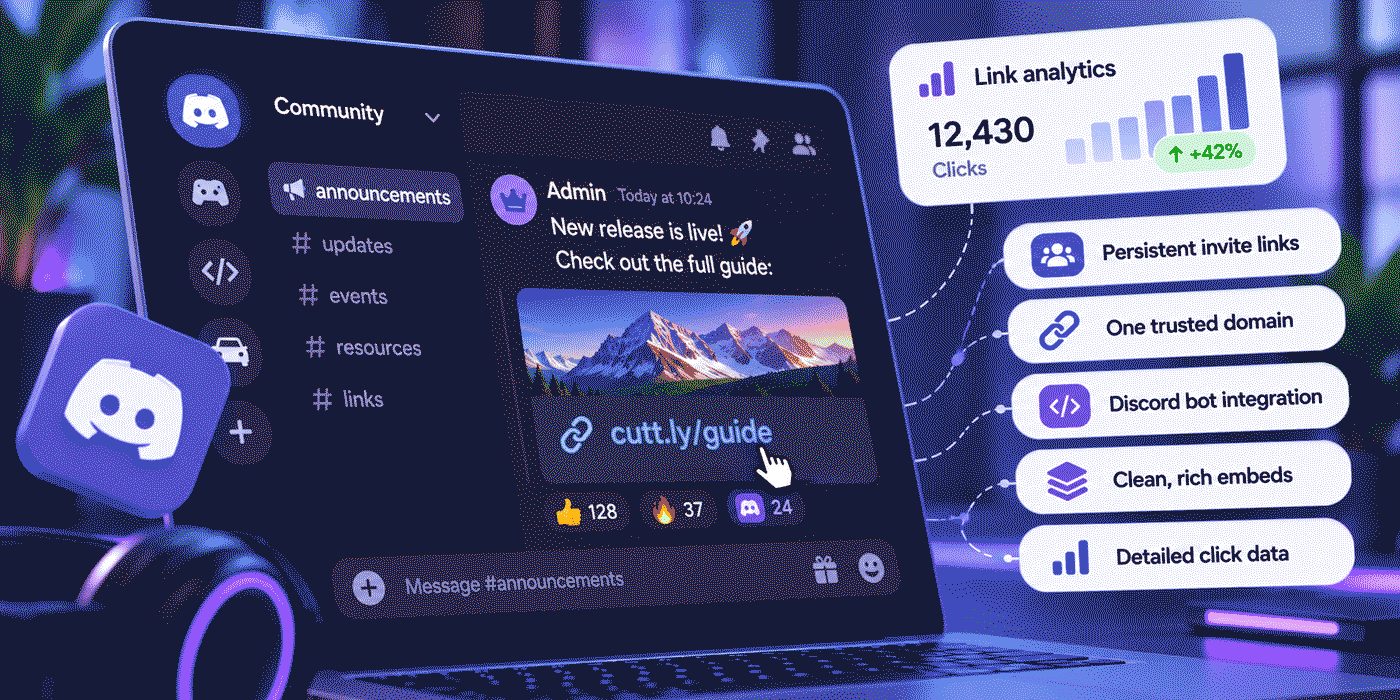
What This Guide Covers
- Where links live on a Discord server
- What Discord measures, and what it leaves to you
- One trusted domain for every official link
- Invite links: expiration, placement, replacement and QR codes
- Clicks versus joins: reading the path into your server
- Announcement channels, embeds and resource channels
- UTM conventions for Discord traffic
- Bots, link buttons and links created through the API
- Moderation, launches, events, surveys and international servers
- A monthly link audit for your server
- Two worked examples, common mistakes and a plan guide
Where Links Live on a Discord Server
A server has more link surfaces than it first appears. Listing them is the first step toward managing them:
- Announcement channels. Releases, updates, events and offers. These links reach the most members and often matter most commercially.
- Rules, welcome and resource channels. Documentation, guides, FAQs, store pages, social profiles. These links are read for months, sometimes years, after they were posted.
- Conversation channels. Links shared by moderators and members in context, often the same resources asked for again and again.
- Bots. Welcome messages, command responses and link buttons under bot messages.
- Profiles. Server owners and creators often put a link in their own profile, which members open when they want to know more.
- Invite links. The way into the server, shared on websites, in videos, in emails, on social profiles and on printed material at events.
The first five send people out of Discord. The last brings people in. Short links work in both directions, and each surface benefits in a different way.
What Discord Measures, and What It Leaves to You
Discord's built-in Server Insights are available to Community servers with more than 500 members, for people with the permission to view them. They cover growth and activation, including where new members came from, engagement such as how many members are active and which channels are used most, the audience's countries and how long members have stayed, and statistics for announcement channels and the welcome screen. The invites list in server settings also shows how often each invite has been used.
That is a solid picture of the community itself. What it is not designed to show is what happens when members leave the server through your links: how many people opened the store page from an announcement, which resource in the rules channel is used, whether the merch link in the welcome message does anything. Smaller servers below the Insights threshold have even less to go on.
A short link closes that gap. Every Cuttly short link has its own analytics on every plan: clicks by day, devices, operating systems, browsers, countries and the language set on the device. Analytics are aggregated and anonymized, so they show how many clicks a link received rather than which member clicked, and statistics are private by default. Combined with Discord's numbers, they show both halves of the story: how the community behaves inside the server, and where it goes when it leaves.
One Trusted Domain for Every Official Link
Discord users have seen every kind of link scam: fake giveaways, imitation servers, lookalike addresses, compromised accounts posting "free item" links in every channel they can reach. Experienced members treat unfamiliar links with suspicion, and moderators spend real time removing them. A community that sends people to the right places needs its official links to be recognizable at a glance.
A branded short domain does that. When every official link from your server and your team uses one domain, such as go.your-studio.co/patch-notes, members learn a single rule: official links look like this. Put the rule in writing in your rules or welcome channel: "Official links from our team always start with go.your-studio.co. Anything else claiming to be from us is not." Imitators cannot use your domain, and the rule gives members and moderators a simple test.
There is a practical benefit inside the Discord app as well. Discord can show a notice before opening an external link that names the destination domain and lets the user trust it. With one branded domain behind all your links, members who choose to trust it once are dealing with one domain they recognize every time, rather than a different address for every resource.
On the platform side, Cuttly Safe Redirecting assesses links when they are created and can refuse to shorten prohibited destinations, and a blocked link shows a warning screen at click time instead of forwarding silently. Destinations on recognized public blocklists are grounds for disabling a link, and anyone can report a suspicious Cuttly link at cutt.ly/report. The full picture is in Is Cuttly Safe?
Setting Up the Domain Before the First Link
Connect the branded domain first. The domain of an existing short link cannot be changed later, so any link created on the cutt.ly domain while you wait would stay there. Choose a dedicated short domain or an unused subdomain: connecting it means pointing its DNS A record to Cuttly and adding a DNS TXT record for verification at your registrar, and a website on that exact hostname would stop being available. The Free and Starter plans include 1 branded domain with SSL configured on your side. From Single you can connect up to 5 domains, SSL through Let's Encrypt is included, and a root page redirect and 404 redirect send visitors who type the bare domain or a mistyped alias somewhere useful. Step-by-step setup is in the custom domain guide.
Invite Links: The Front Door That Keeps Moving
Why Invites Need a Stable Address
Discord invites are flexible, and that flexibility is exactly what makes them fragile outside the server. By default a new invite link is valid for 7 days, unless the channel already has other settings. Invites can be set to last as little as 30 minutes, can be limited to a number of uses, and, depending on the server, can be set never to expire. Admins can remove invites or pause them entirely. Each of these is useful for moderation, and each can break the link on a website, in a video description or on a poster.
Putting a short link in front of the invite separates the address you publish from the invite behind it. The address in the video description stays go.your-studio.co/discord forever. When the invite behind it expires, is replaced or is removed after a raid, you create a new invite and edit the short link's destination, from the Starter plan. Every published copy of the address, including the ones you can no longer edit, starts working again.
Keep Invite Edits Within One Domain
On Starter and Single, a destination edit must stay on the same domain as the current destination; on Team and Team Enterprise it can be any URL. Discord invites can appear in more than one form, so pick one form and use it every time you create or replace an invite. Replacing one invite with another in the same form is then a same-domain edit that works on Starter and Single. The steps for editing are described in the support article on changing the destination of a short link.
One Short Link per Placement
Discord can already tell you how often each invite was used, provided each placement has its own invite. Short links add detail outside Discord: create one per place the invite appears, such as discord-yt for video descriptions, discord-site for the website, discord-newsletter and discord-booth for an event, each pointing to its own invite. Then you can see, for every placement, how many people clicked or scanned, and in Discord, how many of them joined.
Clicks Versus Joins
That pairing is one of the most useful numbers a community manager can have. If a placement produces many clicks but few joins, people are interested but something stops them on the way in: they may need to create a Discord account first, install the app on a phone, or pass a verification step on your server. If clicks and joins are close, the path works. Compare placements against each other, and improve the weak ones, for example by saying "free Discord account required" next to the link, or by simplifying the welcome flow.
QR Codes for Events and Print
Every Cuttly short link has a QR code on every plan, which turns an invite into something you can print on a convention booth, a game box insert, a classroom handout or a sticker. Each scan counts as a click on that link. From Single, QR codes can be customized with your colors, shapes and logo and downloaded in SVG for print, as well as PNG, JPG and WEBP. Settle the alias before printing, because changing a short link's alias changes its QR code and the printed code stops working. The QR code generator guide covers sizes and placement.
Announcement Channels
One Short Link per Announcement
Announcements are where most outgoing clicks happen, so they deserve the cleanest data. Give every announcement that links somewhere its own short link, even when two announcements point to the same page. The patch notes link in Tuesday's update and the reminder on Friday should have separate links, so you can see which one moved people. Links that members only tap do not need custom aliases; Cuttly generates aliases automatically, and your domain already tells members the link is official. Keep custom aliases, which are limited to 3 a month on Free and 30 on Starter and unlimited from Single, for links people will read, remember or type.
Give each announcement link a title in the dashboard, available from Starter, that names the channel and the post, such as "Announcements: season 2 trailer". After a few months you will have dozens of announcement links, and titles are what let you see at a glance which trailers, patch notes and offers produced the strongest response, without reconstructing it from dates.
Published Announcements Reach Other Servers
On Community servers, announcement channels can be followed by other servers. When you publish a message, it appears in every server that follows the channel, embeds and images included. Discord allows up to 10 published messages per hour, and edits to a published message update it in following servers too. That makes announcements a broadcast channel well beyond your own member list.
For links, that has two consequences. Clicks from following servers arrive through the same link as clicks from your own members, so the short link counts the full reach of the announcement. And while Discord propagates edits to followers, announcements also get quoted, screenshotted and pasted into other places you cannot edit: direct messages, forums, social posts. A short link keeps those copies useful, because you can change where it leads without touching any of them.
Embeds: Control the Preview
When a message contains a link, Discord typically shows an embed: a preview with the page's title, description and image. For short links, the embed usually reflects the destination page, so the title, description and image your page provides are what members see. Before an important announcement, post the link in a private test channel and check the embed.
- One embed per message works best. A message with several links can produce several previews and push the text out of view. Suppress the embeds you do not need, for example by wrapping a link in angle brackets when you post it, and let one preview carry the message.
- Embeds are built by automated requests. To create a preview, Discord fetches the page, which can register as early activity on a fresh link. Cuttly applies bot filtering automatically on every plan, and from Single a separate chart shows bot clicks. Judge announcements over days.
- The embed sells the click. A clear page title and an image made for previews matter more on Discord than almost anywhere, because the embed often takes more space in the channel than the message itself.
Rules and Resource Channels: Links That Must Stay Valid
The links in a rules or resources channel are the opposite of announcement links. They are posted once and read for a long time by every new member. They are also the links most likely to break, because documentation moves, stores reorganize and guides are rewritten. A resource channel full of dead links tells new members the community is not looked after.
Give every resource link a stable custom alias that describes it: go.your-studio.co/guide, go.your-studio.co/faq, go.your-studio.co/store. When a page moves, edit the destination. The message in the channel, the copy a member pasted into a direct message last year and the link in the bot's welcome text all keep working. Short links on Cuttly do not expire on their own, which is the right behavior for links meant to last as long as the community does.
Readable aliases help moderators too. When a member asks where the FAQ is, a moderator can type go.your-studio.co/faq from memory instead of searching the channel history. Tag all resource links, for example discord-resources; tags, comments and search by tag are available on every plan, and link titles from Starter make the dashboard list easy to scan.
UTM Conventions for Discord Traffic
Short link analytics count the clicks. UTM parameters let your website analytics show what Discord visitors did next, such as buying, signing up or wishlisting. The UTM builder is available on every Cuttly plan. A convention that works for most servers:
utm_source=discord&utm_medium=community&utm_campaign=season-update&utm_content=announcements
- utm_source is always
discord. - utm_medium matches how you label community or social traffic elsewhere; consistency across platforms is what counts.
- utm_campaign names the release, offer or event, identical in every channel.
- utm_content names the surface:
announcements,resources,welcome-bot,profile.
Clicks from the Discord app often arrive without a referrer, so website analytics may count them as direct visits, and in Cuttly they tend to appear under other or direct sources. That is why the link and its parameters should carry the attribution themselves. Write values in lowercase, keep spellings identical, and keep the convention in a pinned message in your staff channel. More detail is in the guide to UTM parameters with a URL shortener.
Changing Destinations After Posting
Discord lets you edit your own messages, so why edit destinations instead? Because a link rarely stays in one message. It is copied into other channels, other servers, direct messages, pinned posts, bot responses and outside platforms. Editing the destination of the short link fixes every copy at once, including the ones you do not know about.
Destination editing is available from the Starter plan. On Starter and Single, the new destination must be on the same domain as the current one; on Team and Team Enterprise, it can be any URL. That distinction decides the plan for many communities. A studio that only ever points links at its own website can work with Starter or Single. A studio whose "play" link moves from its own landing page to an external store page on launch day needs Team. Log each change in the link's comment or title, because the click chart does not record that the destination changed.
Bots and Link Buttons
Short Links in Bot Messages
Bots greet newcomers, answer commands and post updates, and many of them attach link buttons under their messages. Any of those links can be a Cuttly short link. The welcome bot's "Read the rules", "Get the game" and "Visit the store" buttons each get their own short link, so you can see which ones new members use in their first minutes on the server. Because a button hides the address behind its label, write labels that say exactly where the button goes.
Bots That Create Links Through the API
Bots can also create short links themselves through the Cuttly API, for example when a new video, article or patch note is published, or when a moderator runs a command to share a resource. Every plan includes API access; the rate limit grows with the plan, from 3 calls per 60 seconds on Free through 6 on Starter, 60 on Single and 180 on Team to 360 on Team Enterprise, and monthly link volumes follow the plan as well. Creating links when content is published rather than for every message keeps a bot far below those limits. On the Team plans, the Team API works with a team's own links, and each team has its own API key. Store API keys in the bot's server configuration and never paste them into a channel or a public code repository. Developers will find details in the API developer guide, and no-code approaches in the guide to automation with Zapier and Make.
Moderation and Link Policies
Many servers restrict links, either by letting only certain roles post them or by using moderation tools and bots that remove links from unknown domains. Those policies protect members, and a branded domain makes them easier to run. Instead of maintaining a long list of approved destinations, moderators can allow one domain: yours. Every official resource, store page and event page then reaches members through an address the moderation setup already trusts.
Two further practices help. Keep the domain rule visible in the rules channel, so members know what official links look like. And when your team shares a link, use the short link rather than the raw destination, so the habit stays consistent and members never have to wonder whether a link is real.
Profiles and a Hub Page
Creators, developers and community leads often put one link in their Discord profile and in the server's description of itself. A hub page is usually the right destination: a Cuttly Link in Bio page that lists the website, store, social profiles, newsletter and support. On Free and Starter, the page lives on the cutt.ly domain and holds up to 5 links. From Single, you can use the cutt.bio domain or your own branded domain with an editable alias, add up to 20 links and a video, and run up to 3 pages. Team and Team Enterprise pages carry no Cuttly branding. The Link in Bio guide covers page design.
Launches, Drops and Events
Discord communities gather around moments: a release date, a season launch, a limited merch drop, a live event. Action Pages, available from the Single plan, give those moments a focused page served from a short link under the /c/ path, on cutt.ly or your branded domain, with a title, description, background, logo, optional video, one call-to-action button and an optional countdown.
The countdown can hide the button automatically when it reaches zero, while the page stays active, which suits announcements that keep circulating after a drop closes. From Single, CTR shows how many visitors pressed the button, so you can tell whether the page persuades, not just whether people arrived. Single includes 3 Action Pages, Team 10 and Team Enterprise 20. On Single, the button's destination can be changed only within the same domain; on the Team plans it can be any URL, which matters if the button moves from a signup page on your site to an outside store at launch.
Discord Polls and Cuttly Surveys
Discord has native polls, and for a quick question in a channel they are the right tool. For playtest feedback, course evaluations or community research, you usually need more: several questions, open-text answers, results you can export and share with the team.
Cuttly Surveys provide that, with a short link under the /s/ path, such as go.your-studio.co/s/playtest, and a QR code for live events. Questions can be written in any language, with the survey's buttons set to one of 16 languages, and results export to PDF, XLS or CSV for the team. Before storage, open-text answers are encrypted with 256-bit encryption, and surveys must not be used to collect special categories of personal data, such as health information. Every survey has an end date, with a maximum active period of 7 days on Free, 15 on Starter, 30 on Single, 60 on Team and 90 on Team Enterprise, which fits Discord's rhythm well: announce the survey, keep it open for a defined window, then share what you learned in the announcements channel. The guide to online surveys with a URL shortener covers the full feature set.
International Servers
Many Discord communities span countries and languages, and both sides of the analytics reflect it. Server Insights show the countries of your members. Cuttly's charts show the countries of the people who click and the language set on their devices, on every plan. If a steady share of clicks comes from one language group, a destination page in that language, linked through its own short link, or a dedicated channel for that language is often the next step. Admins and moderators in different countries can manage links in their own language, because Cuttly is available in 48 languages. The guide to multilingual links covers aliases, labels and analytics across languages.
Reading the Numbers
Per Announcement
For each announcement with a link, note the click count after a fixed period, for example three days, and compare announcements of the same type. If your server has Server Insights, compare the link's clicks with the activity in the announcement channel and with your member count at the time. The comparison shows which formats, topics and posting times turn attention into action, which is the question every community manager is eventually asked by someone outside the community.
Timing
Cuttly's chart of clicks by day shows how long an announcement keeps working, on every plan. From Single, Hourly Insights add a heat map of clicks by hour for the last 7 days on Single and 14 days on the Team plans, which helps you find the hours when your community actually responds, across time zones.
The Whole Server at Once
From Single, Aggregated Link Analytics summarize clicks across links, with top links, devices, countries and languages: the last 7 days for up to 10 links on Single, 14 days for up to 25 on Team and 28 days for up to 50 on Team Enterprise. On the Team plans, Cuttly Campaigns provide aggregated analytics for tags: tag every link from your server, or every link in a launch, and see total clicks, hourly activity, devices, sources, languages and locations together, for up to 50 tagged links on Team and 100 on Team Enterprise, over the last 14 days. Link analytics history is kept for 30 days on Free and Starter, 1 year on Single and 2 years on the Team plans. The link analytics guide covers how to read the charts.
Testing Links Inside Discord
Members open Discord on desktop and on phones, and the same link can behave differently in each. Before an important link goes into an announcement, post it in a private test channel and check four things: the embed looks right, the link opens on desktop, it opens on a phone, and the destination completes its job on both, whether that is a purchase, a sign-up or a download. Pay special attention to pages that need a login or that offer a desktop download, because a member on a phone will reach them too. If a destination only makes sense on one kind of device, say so in the announcement.
Mobile Destinations for Games and Apps
Studios and app makers often need one link that serves every device: the app store on phones and the website or desktop store on computers. From the Single plan, Mobile URLs let one short link send Android and iOS visitors to different destinations than desktop visitors. From Team, Deep Links add support for the Play Store and App Store. One "Get the game" link in an announcement then works for everyone who taps it, and the device chart shows how your community splits between platforms.
Events and Livestreams
Scheduled events are a regular part of server life: a weekly stream, a community game night, a launch party, a live Q&A. When an event takes place outside Discord, members need a link to the stream or the event page, and that link tends to be posted in several places: the event itself, the announcement, a reminder, the bot's schedule command. A short link with a readable alias, such as go.your-studio.co/live, gives every one of those places the same address. Each week you point it at the current stream, and members learn that one link always leads to whatever is live now. If the stream sometimes moves between platforms, remember that destination edits across domains need a Team plan; on Starter and Single, keep the link pointing within one platform's domain.
A Monthly Link Audit for Your Server
Servers accumulate links the way old houses accumulate keys. A thirty-minute audit once a month keeps them under control:
- Open every link in the rules and resources channels and confirm the destination still exists and is current. Edit destinations rather than messages.
- Check every published invite short link. Make sure each one still points to a working invite, and replace any invite that has expired or reached its use limit.
- Look at the month's top links in Cuttly and the month's most active channels in Discord, and ask whether the most important destinations are getting the attention they deserve.
- Find links nobody uses. A resource no member opens may be badly named, badly placed or no longer needed.
- Review the bot's buttons and remove or rename the ones members ignore.
- Write one sentence about what you learned and pin it in the staff channel, so the next audit starts from it.
The audit is where the tags and titles you added at creation time pay off: a search by tag lists every Discord link in seconds, and descriptive titles tell you what each link is without opening it.
Worked Example: An Indie Game Studio
A small studio runs a Discord server of a few thousand members around its upcoming game. Links go to the studio website, the game's store page, a playtest signup and a merch shop. The team expects the "play" link to move from its own landing page to an outside store page on launch day, so it chooses Team, where destinations can change to any URL. Three people manage links in one Cuttly team: the community manager, a developer and the producer.
The studio connects go.your-studio.co before anything else and adds a line to the rules channel saying that official links always use that domain. The rules and resources channels get stable aliases: guide, faq, store, merch. The public invite sits behind go.your-studio.co/discord on the website, with separate short links for video descriptions and for a convention booth, each pointing to its own invite. At the convention, the booth link is printed as a QR code in the game's colors.
Every announcement gets its own short link with the tag discord and UTM parameters. The studio's bot creates links through the Team API when a devlog is published and posts them with a "Read the devlog" button. For a closed playtest, the team runs a 30-day Cuttly survey for feedback and shares the results in the announcements channel afterward.
Three months in, the comparison of clicks and joins shows that the convention QR code produced many scans but relatively few joins, while the video description link converted well. Talking to players, the team learns that many booth visitors did not have a Discord account on their phone. For the next event, the booth sign adds "free Discord account needed" and a second QR code for the playtest signup, which needs no account. On launch day, the community manager edits the "play" link to the store page, and every announcement, video description and message that ever contained it now leads to the right place.
Worked Example: An Online Course Community
An online course creator runs a Discord server for students: lesson discussions, weekly live sessions, a resources channel and a members-only area. The course lives on the creator's own website, and the creator works alone, so Single fits: enough links, unlimited custom aliases, SSL included for the short domain and a year of analytics history to compare one course intake with the next.
The invite to the server lives behind go.your-domain.co/community, which appears in the course welcome email and on the course dashboard. Because invites for the members-only server are limited in uses for each intake, the creator creates a new invite before every intake and edits the short link to point to it. As the new invite is in the same form as the old one, that is a same-domain change and works on Single. Welcome emails sent to earlier intakes keep working too.
The resources channel uses aliases students can type, such as workbook, schedule and replays, and the live session link is a short link whose destination the creator edits each week to the new session page on the course site. A Link in Bio page in the creator's profile gathers the course page, the newsletter and social profiles. After each intake, a two-week survey collects feedback on the community. The language chart shows that a growing share of clicks comes from Spanish-language devices, and the creator starts a Spanish discussion channel with its own resource links.
Common Mistakes
- Publishing raw invite links. They expire, run out of uses or get removed, and every published copy breaks. Put a short link in front and repoint it.
- Mixing invite formats. On Starter and Single, invite replacements must stay on the same domain. Use one invite form consistently.
- Official links on many domains. Members cannot tell real from fake. Use one branded domain and state it in the rules channel.
- One link for many announcements. Clicks merge, and nothing can be compared. Give each announcement its own link.
- Letting resource links rot. Use stable aliases and edit destinations when pages move.
- Several embeds in one message. Suppress the previews you do not need, and let one embed carry the message.
- Judging links in the first minutes. Embed requests and other automated traffic appear early. Read results over days.
- Chaining short links. Point every short link directly to its destination. Links with more than one redirect, or already shortened elsewhere, can be blocked.
- API keys in public places. Keep keys in the bot's configuration, never in a channel or public repository.
- Skipping the phone test. Test every important link on desktop and mobile before announcing it.
The Short Version
Connect one branded domain before creating any links, and tell members in the rules channel that official links always use it. Put every published invite behind a short link, one per placement, and repoint it whenever the invite changes, keeping replacements in the same invite form so they stay same-domain edits. Give each announcement its own short link and each resource a stable alias. Check embeds before posting and read results over days. Use UTM parameters with utm_source=discord and the surface in utm_content. Let bots use short links in buttons, or create them through the API. Compare clicks with joins and with Discord's own statistics, and use the gaps to improve the path into your server and out of it.
Choosing a Plan for Discord
Four questions settle it. Do you need to repoint invites and resources? Destination editing starts at Starter, so most servers need at least Starter. How many links and custom aliases a month? Starter allows 300 links and 30 aliases; Single allows 5,000 links and unlimited aliases. Will destinations move between domains, for example from your site to an outside store at launch? That requires Team. Who manages links? One person can work on any plan; several staff members with roles point to Team.
Cuttly Plan Guide for Discord
The Free plan ($0) lets you try the approach: 30 short links and 3 custom aliases a month, 1 branded domain with SSL configured on your side, QR codes, the UTM builder, tags, API access, one Link in Bio page and 30 days of analytics. Destinations cannot be edited on Free. Registration is required; no credit card is needed.
The Starter plan ($12/month) is the minimum for keeping invites alive: destination editing within the same domain, 300 short links and 30 custom aliases a month, link titles and more control over the Link in Bio page.
The Single plan ($25/month) suits active communities: 5,000 short links a month with unlimited custom aliases, up to 5 branded domains with SSL included, root page and 404 redirects, customizable QR codes with SVG download, 1 year of analytics, Hourly Insights, a bot chart, Aggregated Link Analytics, Mobile URLs, Action Pages and Link in Bio pages on cutt.bio or your own domain.
The Team plan ($99/month) fits studios and organizations with several staff members: destination editing to any URL, Deep Links, 2 years of analytics, Campaigns analytics for tags, up to 3 teams with 5 members each and five roles, the Team API and Link in Bio pages without Cuttly branding.
The Team Enterprise plan ($149/month) is built for publishers and organizations running many servers or brands: up to 10 teams with 20 members each, 50,000 short links a month, 99 branded domains, 360 API calls per 60 seconds and SSO.
Start with the front door: create a free Cuttly account, connect your domain, and put your server's invite behind a short link you control. Registration required; free plan available with no credit card needed.
Frequently Asked Questions
Can I track clicks on links shared in Discord?
Yes. Every click on a Cuttly short link is counted, with charts by day, device, country and language. Analytics are aggregated and anonymized: you see how many clicks a link received, not which member clicked.
Can I put a Discord invite link behind a short link?
Yes. Point a short link or QR code at your invite. When the invite expires, runs out of uses or is removed, create a new one and edit the short link to it, from Starter. Everything already published or printed keeps working.
Will Discord show an embed for a short link?
Usually the embed reflects the destination page, using its title, description and image. You can suppress the embed for an individual link, which helps when a message contains several links.
Can I change where a link goes after posting it?
Yes, from Starter. Every message containing the link, including copies outside your server, leads to the new destination. On Starter and Single it must be on the same domain; on the Team plans it can be any URL.
Can a Discord bot create Cuttly short links?
Yes, through the Cuttly API, available on every plan with rate limits from 3 calls per 60 seconds on Free to 360 on Team Enterprise. Bots can use the links in messages and link buttons.
Do I need a paid plan?
Not to start. Free includes 30 short links and 3 custom aliases a month, 1 branded domain, QR codes and 30 days of analytics. Registration is required, and no credit card is needed. To repoint invites and resources, you need Starter or above.
- COMMUNITY
- URL Shortener →
- Link in Bio Builder →
- QR Code Generator →
- Channel Guides
- URL Shortener for Telegram
- URL Shortener for WhatsApp
- URL Shortener for Email Signatures
- Setup and Tracking
- Custom Domains for Short Links
- UTM Parameters Guide
- Link Analytics Guide
- Campaigns: Analytics for Tags
- Bots and Automation
- API Developer Guide
- Zapier and Make Automation
- This Series
- URL Shortener in 48 Languages
- Is Cuttly Safe? Security and Privacy
- Is Cuttly Free? Pricing Explained
- Support Docs
- Changing a Link's Destination
- Support: Is Cuttly Safe?
- Encyclopedia
- Branded Links
- Link in Bio
- Verticals Hub
- URL Shortener for Every Industry →
- Start Here
- Create Free Account
- Plans & Pricing
URL Shortener
Cuttly simplifies link management by offering a user-friendly URL shortener that includes branded short links. Boost your brand’s growth with short, memorable, and engaging links, while seamlessly managing and tracking your links using Cuttly's versatile platform. Generate branded short links, create customizable QR codes, build link-in-bio pages, and run interactive surveys—all in one place.
Cuttly More Than Just a URL Shortener
Cuttly is a comprehensive, ever-evolving platform for link shortening that combines innovation and user-friendliness to deliver a seamless experience in managing and shortening URLs.


