URL Shortener for Furniture Stores and Home Décor Retailers: The Complete Guide
Furniture and home décor retail is defined by one of the longest, most considered customer journeys in consumer retail. A customer who walks into a furniture showroom on a Saturday afternoon and walks out without buying is not necessarily a lost sale — they may be three weeks from a house move, six weeks from a renovation completion, or simply a deliberate shopper who visits twice before committing to a significant purchase. The showroom visit is often the beginning of a journey, not the end. The challenge for furniture retailers is staying relevant and accessible throughout that journey — from the showroom visit through the at-home consideration phase, through the partner consultation, through the return visit or online order, to delivery, assembly, and the post-purchase relationship that generates referrals and repeat purchases. A URL shortener with a branded domain is the thread that connects every stage of this journey: a QR Code on a showroom price tag that lets a customer save a product for later consideration at home; a branded short link in a post-visit follow-up email that routes to exactly the sofa they were looking at; a tracked link in an Instagram post that measures how many followers converted from inspiration to product page view. This guide covers how furniture stores, home décor retailers, and interior product showrooms use branded short links, QR Codes, and link analytics across every stage of the furniture purchase journey.
What This Guide Covers
- The omnichannel challenge: showroom, online, and the gap between
- Showroom QR Codes on price tags and product displays
- Room set QR Codes: the complete look in one scan
- Fabric, finish, and material sample QR Codes
- Printed catalogues and brochures: bridging print and digital
- Post-visit follow-up: sending the right product link at the right moment
- Instagram and Pinterest: the most important social platforms for furniture retail
- Email marketing: tracking which campaigns drive product views and purchases
- Seasonal campaigns: new collections, sale events, and room refresh promotions
- Delivery confirmation and assembly guide links
- Customer care and product maintenance QR Codes
- Interior design consultation and room planning services
- Trade and interior designer B2B links
- Google Reviews and post-purchase reputation building
- Multi-location furniture chains: team link management
- Which Cuttly plan is right for a furniture retailer
The Omnichannel Challenge: Showroom, Online, and the Gap Between
Furniture retail is structurally omnichannel in a way that most other retail categories are not. Apparel retail has primarily moved online for repeat purchases, with physical retail for discovery and try-on. Grocery is split between in-store and home delivery. Furniture occupies a unique position: the showroom remains essential (customers want to sit on the sofa, feel the fabric, see the scale relative to themselves and their body) but the purchase frequently completes online or on a return visit, after a period of home deliberation.
Research from multiple furniture retail surveys consistently shows that 60% to 80% of furniture purchase journeys begin online (search, social media, lifestyle content) before any physical touchpoint, and that a significant proportion of showroom visitors complete their purchase online rather than in-store. The customer who photographs the price tag, takes a business card, and says "I'll think about it" is a warm lead who needs the right follow-up — not an abandoned sale.
This is the fundamental problem that QR Codes on price tags and branded short links in follow-up communications solve. The customer who photographs the price tag has demonstrated specific interest in that product. A QR Code on the tag that links to the full product page — with all available finishes, dimensions, delivery lead times, and the ability to add to a wishlist or share with a partner — captures that interest digitally at the moment it peaks. The retailer who provides this mechanism converts a physical product interaction into a measurable digital engagement that can be followed up.
Without this mechanism, the showroom visit generates no digital data. With a QR Code on every price tag linked to a tracked short link, every product that generates customer interest in the showroom generates a data event — even if no purchase happens that day. Aggregate data over a month shows which showroom products are generating the most digital follow-up engagement from visitors. Products with high showroom QR Code scan rates but low conversion to purchase may need price adjustment, availability improvement, or a different showroom positioning.
Showroom QR Codes on Price Tags and Product Displays
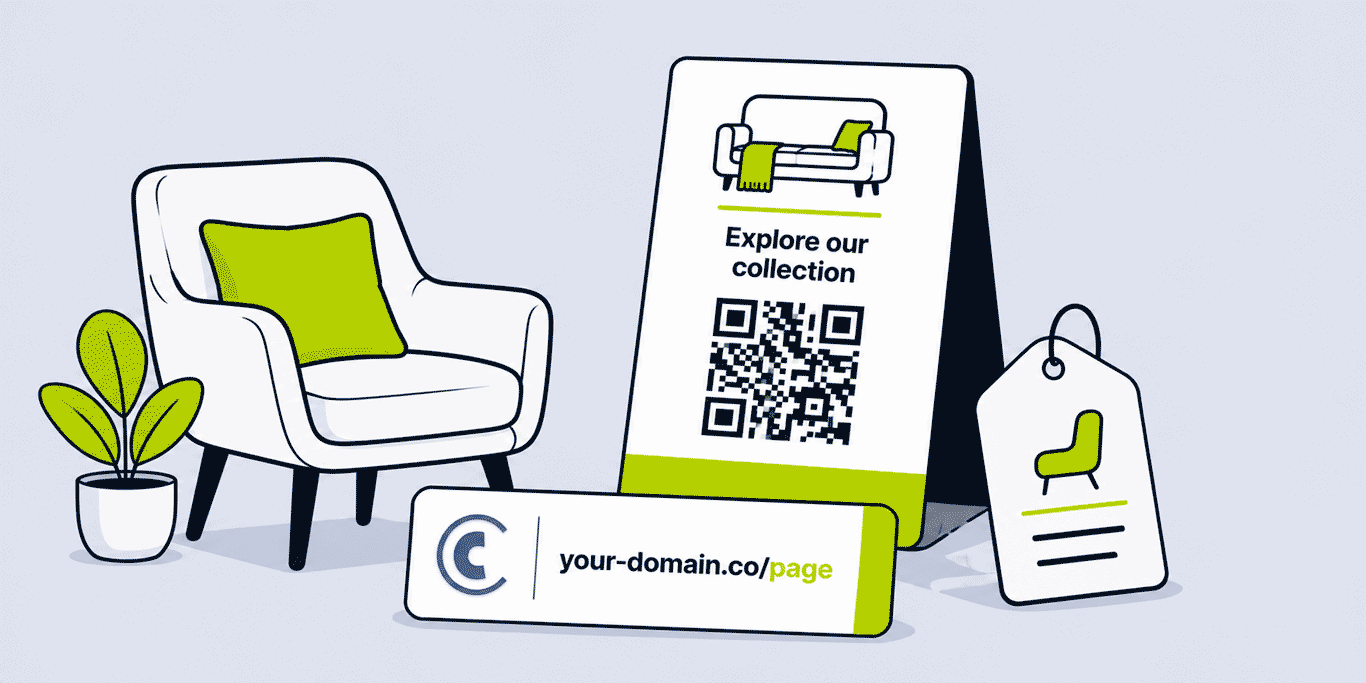
The most fundamental application of QR Codes in furniture retail is on the product price tag or display label. Every product in the showroom that has a price tag has a QR Code opportunity. The QR Code links to the full product page — not the homepage, not a category page, but the specific product with its full range of information.
The full product page accessible via QR Code provides what the physical tag cannot: all available upholstery or finish options (with colour swatches), all size variants, the product's full dimensions, the care and maintenance guide, the delivery lead time (often the most urgent question for customers managing a renovation timeline), customer reviews, and the ability to add to a wishlist, share with a partner, or start a purchase.
The QR Code on the price tag must be dynamic — generated from a Cuttly short link — for two reasons. First, product pages change: products go out of stock, are discontinued, are updated with new variants, or are moved to sale. A dynamic QR Code's destination can be updated in Cuttly when the product status changes — to the updated product page, to a similar alternative, or to a "this product is now discontinued — here are our current recommendations" page. A static QR Code encoding the product page URL produces a broken experience if the URL changes. Second, the scan analytics from the dynamic QR Code show which specific showroom products are generating the most digital engagement — data unavailable from static codes.
For the QR Code design on furniture price tags: use the store's brand colors with sufficient contrast (dark branded color on white background), error correction level H for print resilience, and a minimum size of 2 cm × 2 cm on the tag. Include a brief call to action on the tag: "Scan to see all finishes & delivery times." Including the specific CTA increases scan rates measurably compared to a QR Code with no label.
Download QR Codes in SVG format from Cuttly for professional print production — SVG scales to any size without quality degradation, ensuring the QR Code on a small tag is as sharp as one on a large display card.
Room Set QR Codes: The Complete Look in One Scan
Furniture showrooms typically arrange products in room sets — styled living room displays, complete bedroom arrangements, dining room configurations — that show products in a coherent interior context rather than in isolation. Customers are often inspired by the complete look as much as by individual pieces. The room set's commercial value is the aspiration it creates: "I want my living room to look like this."
A QR Code on a prominent display card within each room set links to a curated page listing every product in the display: sofa, coffee table, rug, cushions, sideboard, lighting, decorative accessories — each with a link to its individual product page and price. The customer who loves the complete living room display scans once and has immediate access to every component.
This "room set" QR Code is particularly powerful because it captures the customer's aspiration at its most concrete expression — they are standing in a styled room they want to recreate. Analytics on the room set QR Code show: how many showroom visitors scan the complete room (aggregate interest), which individual product links within the room set page are clicked most (which pieces have the highest individual purchase intent), and when scans happen (are they primarily weekend browse-and-save or weekday specific-purchase intent?).
Room set QR Code pages should be maintained as the display changes seasonally or with stock updates. Because the QR Code on the display card routes to a Cuttly short link whose destination can be updated, the physical card does not need to be reprinted when the room set is refreshed. Update the short link destination to the new room set product list and the existing card continues to work. This is practically significant for retailers who rotate room set displays seasonally — spring/summer and autumn/winter displays, new collection arrivals, clearance configurations.
Fabric, Finish, and Material Sample QR Codes
Fabric and finish selection is one of the most high-friction moments in the furniture purchase journey for customisable pieces. A sofa available in 60 fabric options, a dining table available in 8 wood finishes and 5 leg colors, a cabinet available in 12 paint colors — the decision requires seeing the full range, understanding the price differential between grades, and ideally taking a sample home to see it in the actual room's lighting conditions.
A QR Code on each fabric swatch board or finish sample card in the showroom links to the complete digital range for that product line: all fabric options with lifestyle photography showing how each looks in a room context, the fabric grade and associated price tier, and any lead time differences between grades. A customer who is interested in a sofa but undecided on fabric can scan the swatch board QR Code and spend as long as needed browsing the full range on their phone — without requiring staff involvement for every fabric question.
For retailers who offer fabric or finish sample packs for home trialling — small samples mailed or given to customers to test in their own space — including a QR Code on the sample envelope or card links back to the full product page for that fabric or finish, with a pre-populated "order samples" function. The customer who has been trialling fabric samples at home and is ready to purchase visits the product page with one scan rather than having to search the retailer's website.
Sample pack QR Codes should be dynamic — if the product page URL changes or the product is updated, all existing sample cards in circulation continue to work. Track sample pack QR Code scan rates to understand how many customers who receive samples follow up digitally — a practical signal of sample-to-consideration conversion rate.
Printed Catalogues and Brochures: Bridging Print and Digital
Many furniture retailers still produce printed catalogues — seasonal collections, lookbooks, and specialist category brochures. These printed materials are distributed in-store, by mail to customer databases, at trade and consumer shows, and sometimes inserted in local newspapers and magazines. They drive showroom footfall and inspire consideration, but their direct impact on sales is difficult to measure without a mechanism to bridge from print to digital.
QR Codes throughout the catalogue — one per product or product group, linking to the relevant digital product page — convert every printed page interaction into a measurable digital event. A customer who receives the spring catalogue, browses it over a weekend, and scans the QR Code on a dining table they find interesting has demonstrated specific purchase intent that the retailer can now act on.
Create unique short links per catalogue edition for the main catalogue call-to-action QR Code (the link to the full online shop or to a landing page aggregating the catalogue's featured products): go.furniturename.com/spring-catalogue-2026. Analytics on this link show total catalogue engagement — how many people who received the catalogue actually followed up digitally. Comparing this across catalogue editions shows whether catalogue ROI is growing or declining, informing printing and distribution investment decisions.
For the individual product QR Codes within the catalogue: use the same per-product short links used in the showroom. A product whose showroom QR Code and catalogue QR Code both use the same base link (differentiated only by the alias suffix: product-sku-catalogue versus product-sku-showroom) generates analytics showing the relative contribution of showroom versus catalogue to that product's digital engagement.
Post-Visit Follow-Up: The Right Product Link at the Right Moment
The post-visit follow-up — an email or text sent to a customer who visited the showroom, did not purchase, and left contact details — is one of the highest-value marketing activities in furniture retail. A customer who provided their email during a showroom visit and is followed up within 48 hours with a direct link to the specific products they expressed interest in is far more likely to convert than one who receives a generic "thank you for visiting" email with a link to the homepage.
The mechanics: during the showroom visit, staff note which products the customer expressed interest in. The post-visit follow-up email includes branded short links to each of those specific products — not the homepage, not a general category page, but the exact sofa, the exact dining table, the exact rug. The links use tracked aliases that identify both the product and the follow-up context: go.furniturename.com/follow-sofia-sofa-june12.
Analytics on post-visit follow-up links show: which customers are re-engaging with the specific products after visiting (clicking the product links in the follow-up email), which products are generating the highest post-visit click rates (potentially underpriced or underdisplayed relative to interest), and which sales advisors' follow-up emails generate the most post-visit product engagement (an indirect measure of follow-up email quality). This data informs both individual follow-up strategy and broader showroom and sales training decisions.
Instagram and Pinterest: The Most Important Social Platforms
Instagram and Pinterest are the dominant social platforms for home décor discovery and furniture inspiration. Pinterest is a deliberate, aspiration-driven platform — people pin room ideas they are actively planning to implement. Instagram is a visual inspiration platform where interior content (room photography, product reveals, styling advice) reaches audiences in an awareness and consideration phase. Both require a consistent, professional short link strategy.
A Link in Bio page on the retailer's branded domain — go.furniturename.com/links — aggregates: the new collection link (most prominent button), the room inspiration lookbook, the current sale or promotion, the store locator, an appointment booking for design consultation, and the online shop. Analytics on the Link in Bio page show which destinations Instagram and Pinterest visitors engage with most — whether they are primarily browsing inspiration (lookbook button) or actively purchase-intent (shop and consultation buttons).
Per-post tracked links are important for measuring which content types drive the most product engagement from social media. An Instagram post featuring a styled living room with a QR Code or Story link sticker to the featured sofa generates analytics showing how many followers clicked through to the specific product page. Comparing click rates across post types — full room shots versus product close-ups versus before/after styling reveals versus lifestyle use videos — tells the marketing team which content format their specific audience responds to most commercially.
Pinterest links — included in pin descriptions and linked to specific product pages — are tracked via UTM parameters (Cuttly's built-in UTM builder, all plans). A Pinterest pin that generates 200 product page visits per month from organic pinning by followers and other users represents significant, low-cost organic traffic from a high-intent audience. Branded short links make these pins' destinations clean and trustworthy regardless of how they are shared across the platform.
Seasonal Campaigns: New Collections, Sale Events, and Room Refresh Promotions
Furniture retail follows distinct seasonal patterns — spring/summer collections, autumn/winter new arrivals, January sales, Black Friday, and periodic clearance events. Each of these campaigns requires a focused link strategy that makes the campaign accessible from every channel simultaneously while tracking which channels drive the most engagement.
Each campaign gets: a campaign landing page or product collection page, a branded short link to that page, and separate tracked versions of that link per distribution channel. The spring collection campaign short link — go.furniturename.com/spring-2026 — is the stable campaign URL. The email version (spring-2026-email), the Instagram Stories version (spring-2026-ig), the catalogue insert version (spring-2026-catalogue), and the in-store QR Code version (spring-2026-instore) each generate independent analytics — all routing to the same spring collection page.
Cuttly's Action Pages (Single plan+) are particularly useful for limited-time sale events: a standalone sale landing page with the sale headline, featured categories, end date and countdown timer, and a "Shop the Sale" CTA. Created in minutes without a website build, accessible via a branded short link distributed in all channels, with analytics tracking campaign visits and button click-through rate. When the sale ends, the Action Page is updated to a "Sale now ended" message or redirected to the standard collection page — all existing links continue to route correctly.
Link expiration by date (Single plan+) is useful for sale campaigns with hard end dates — a "48-hour flash sale" link can be set to expire after 48 hours, automatically routing late arrivals to an appropriate post-sale page without manual intervention.
Delivery Confirmation and Assembly Guide Links
The post-purchase experience in furniture retail is shaped heavily by the delivery and assembly process — arguably the most anxiety-prone stage for customers who have made a significant investment in a large piece. A customer who has ordered a flat-pack wardrobe and receives a delivery confirmation with a branded short link to a step-by-step video assembly guide has a markedly better post-purchase experience than one who receives a generic confirmation with a paper instruction sheet folded in the box.
A branded short link to the product's assembly guide — go.furniturename.com/assembly-product-sku — is included in the delivery confirmation email and, ideally, printed on a card inside the packaging box. Both the email link and the packaging card QR Code are tracked separately — analytics show how many customers access assembly guides digitally (indicating they prefer video over paper instructions) and when they access them (immediately on delivery, or the evening of assembly day — useful data for planning when to send assembly support communications).
Assembly guide links must be dynamic. If the product has its assembly video updated, or if the guide is moved to a new hosting platform, the short link destination is updated and all existing packaging cards and previously sent emails route to the current guide. This is particularly important for products with long shelf life in the retailer's catalogue — a core wardrobe that sells for 5 years may have packaging cards from year 1 that need to route to the current year's assembly video.
Customer Care and Product Maintenance QR Codes
Furniture care — how to clean a leather sofa, how to maintain a solid oak dining table, how to care for a velvet upholstered chair — is important product information that most retailers underutilise as a customer engagement tool. A customer who receives clear, useful care guidance for their new purchase has a better long-term product experience, is less likely to damage the piece and blame the retailer, and is more likely to return for their next purchase feeling positively about the brand.
A QR Code on a care card included with every delivered piece — linking to the product's specific care guide, including recommended cleaning products, maintenance schedules, and what to avoid — is a premium post-purchase touch that most furniture retailers do not provide. A branded short link on this care card — go.furniturename.com/care-leather-sofas — is on the retailer's domain, bookmarkable, and updatable if the care guidance changes.
Analytics on care guide links reveal ongoing customer engagement with the brand long after the purchase — a customer who accesses the care guide 6 months after delivery is still actively using the piece and thinking about it. This is a signal worth acting on: a well-timed "loving your [product name]? Here's what's new in our collection" email, timed to correspond with when the care guide analytics show high engagement, is a contextually relevant retention marketing touchpoint.
Interior Design Consultation and Room Planning Services
Many furniture retailers offer complimentary or paid interior design consultation services — helping customers plan a room, select furniture that works together, and create a coherent scheme. These services are high-value for conversion (customers who use the consultation service convert at significantly higher rates and purchase larger baskets) and for retention (customers who have an ongoing design relationship with the retailer return for subsequent rooms and purchases).
A branded short link to the design consultation booking form — go.furniturename.com/design-consultation — should be prominently featured in the showroom, in all email communications to customers who have browsed high-value products without purchasing, in the post-visit follow-up email, and in social media profiles (second button after the main shop link in the Link in Bio page). Tracked analytics on this link show how many customers are actively interested in the consultation service.
A room planning tool or 3D room visualizer — available on many furniture retailers' websites — should also have its own branded short link: go.furniturename.com/room-planner. Distributing this link in post-visit emails ("Want to see how this sofa looks in your room? Try our 3D room planner") converts a showroom browser into a digitally engaged prospect who invests time in the brand's tools — a strong purchase intention signal.
Trade and Interior Designer B2B Links
Many furniture retailers offer trade accounts for interior designers, property developers, hospitality operators, and corporate procurement teams. These B2B customers often represent higher-value, repeat purchase relationships — a single interior designer who regularly specifies furniture for their projects can generate significant annual revenue.
A branded short link to the trade account application and trade portal — go.furniturename.com/trade — should appear on the retailer's website, in LinkedIn content targeting interior design and property development professionals, and on any exhibition or trade fair materials. Analytics on the trade link show how many professionals are actively exploring the trade programme — useful for understanding demand levels and whether a dedicated trade marketing effort is justified.
For active trade account clients, a link to the trade-specific product catalogue with trade pricing — distinct from the consumer-facing catalogue — should be a password-protected branded short link (Single plan+). The interior designer accesses their branded link, enters the password provided when the trade account was approved, and accesses the trade price list. Professional, frictionless, and on the retailer's brand — not exposed to casual price comparers.
Google Reviews and Post-Purchase Reputation Building
Google Reviews for furniture retailers influence both online discovery and in-store footfall decisions. A local furniture showroom with 300 reviews and a 4.7 average is dramatically more credible than one with 35 reviews when a consumer is deciding which showrooms to visit on their Saturday furniture shopping trip. For premium or specialist retailers competing with well-known chains, an exceptional Google review profile is one of the most powerful levelling tools available.
The highest-conversion moment for a Google Review request in furniture retail is 7 to 14 days after delivery — enough time for the piece to be assembled, positioned, and genuinely appreciated, but not so long that the purchase excitement has faded. A branded short link to the Google Review page — go.furniturename.com/review — in a post-delivery email at day 7 or 10 ("How are you enjoying your [product name]? We'd love your feedback") generates reviews at peak satisfaction.
Include both the branded short URL and a QR Code on the care card included with every delivery — customers who have not yet left a review can scan at any point during product use. Analytics on the review link show click-through rate from each distribution channel (post-delivery email versus care card QR Code), enabling optimisation of the review generation programme over time.
Multi-Location Furniture Chains: Consistent QR Codes Across Every Showroom
Furniture retailers operating multiple showroom locations — whether a regional chain of 5 stores or a national retailer with 30 — face a specific challenge: ensuring that the QR Code and short link infrastructure is consistent across every location, so that the customer experience does not vary between stores and so that analytics across locations are comparable. A head office marketing team that manages short link creation centrally while empowering individual store managers to update their local campaign links needs a shared workspace with role-based access — exactly what Cuttly's Team plan provides.
In a multi-location setup: each store's showroom QR Codes share the same visual QR Code style (set once in the shared workspace presets), ensuring brand consistency in every location's price tags, room set display cards, and catalogue materials. Each store's links are tagged with the store identifier — allowing the head office to compare which showroom locations are generating the most product digital engagement from QR Code scans and which locations' customers are most active on social media channels.
National seasonal campaigns — a January sale, a bank holiday promotion, a new collection launch — run simultaneously across all stores with a single campaign page and per-location tracked links. Cuttly Campaigns (Team plan+) aggregates total campaign click volume across all stores, shows the geographic distribution of engagement (confirming whether the campaign is reaching all target markets), and allows per-store comparison without requiring individual export and aggregation by the marketing team. This consolidated view of national campaign performance in a single dashboard saves significant reporting time and enables faster campaign optimisation decisions.
For furniture retailers who run in-store events — new collection preview evenings, interior styling workshops, exclusive private sale events for loyalty customers — each event generates its own short link set: a registration page link distributed per-channel (email to loyalty database, Instagram Stories, showroom display QR Code) and tracked independently. Post-event analytics compare which channel drove the most event registrations across all locations — a direct data point for planning the promotional mix for the next national event programme.
Email Marketing Attribution: Which Campaigns Drive Purchase Decisions
Email marketing for furniture retailers serves a distinctive role compared to most other retail categories. In most retail, email drives immediate purchase — the promotional email generates a click and a transaction within 24 to 48 hours. In furniture retail, email drives consideration and return visits — an email featuring a new sofa may generate a showroom visit two weeks later, or an online purchase three weeks later, or nothing at all until the customer's circumstances change and they recall seeing the sofa in the email six months ago.
This delayed conversion pattern makes attribution challenging — but not impossible with tracked short links and UTM parameters. A branded short link in an email campaign with UTM parameters (utm_source=email, utm_medium=newsletter, utm_campaign=spring-sofas-jun-2026) passes attribution data through to the retailer's website analytics or e-commerce platform. When a customer who clicked the email's sofa link returns three weeks later and completes a purchase, the GA4 data shows that the original email was in their journey — even if the purchase session did not come directly from the email.
Comparing per-campaign email link click rates (from Cuttly analytics) to eventual purchase rates (from the e-commerce platform's UTM attribution) shows which email content types have the highest long-term conversion rate, not just the highest immediate click rate. A lifestyle room photography email may generate moderate immediate click rates but high eventual conversion rates among clickers — evidence that aspirational content works as a purchase catalyst even when it does not drive immediate action. This insight is invisible without both layers of tracking: Cuttly for the click event, UTM for the eventual conversion.
Which Cuttly Plan Is Right for a Furniture Store
The Free plan ($0) provides 30 links/month, 1 branded domain, basic QR Code generation, UTM builder, and 30 days of analytics. No credit card required. Appropriate for very small home décor boutiques or single-category specialist retailers with minimal active marketing. 30 links/month is quickly limiting for a store with a large product catalogue, but adequate for a minimal initial infrastructure.
The Single plan ($25/month) is the right plan for most independent furniture stores and home décor retailers. 5,000 links/month covers the full range of showroom price tag QR Codes, room set displays, catalogue inserts, seasonal campaign links, post-visit follow-up links, and delivery documentation. 1 year of analytics history enables season-over-season comparison of campaign performance and showroom product engagement. Full QR customization with SVG export for professional showroom displays, price tags, and catalogue production. Link in Bio on a branded domain for Instagram and Pinterest. Action Pages for sale events and new collection launches. Password-protected links for trade pricing documentation. Link expiration for time-limited sale campaign links.
The Team plan ($99/month) is appropriate for furniture chains with multiple showroom locations, retailers with integrated e-commerce and POS systems requiring API-based short link generation for product pages, and any retailer running coordinated multi-channel campaigns that benefit from Cuttly Campaigns for aggregated analytics across locations and channels.
Start with Cuttly's free plan — no credit card required, 1 branded domain included. Create your first showroom product QR Codes, set up your Instagram Link in Bio, and build a seasonal campaign short link in under 30 minutes. Registration required; free plan available immediately.
Frequently Asked Questions
Why do furniture stores need a URL shortener?
Furniture retail's long, considered customer journey — showroom visit, at-home deliberation, online or return-visit purchase — requires digital bridges at every stage. A URL shortener with per-channel tracking makes every stage measurable: which showroom products are generating digital follow-up, which campaigns drive product page views, which channels produce actual purchase intent. Branded short links also make long product page URLs shareable on price tags, in SMS follow-ups, and in printed catalogues.
How can a furniture store use QR Codes?
On showroom price tags (full product page with all variants and delivery times), on room set display cards (complete product list for the display), on fabric and finish swatch boards (full digital range for the product line), in catalogues and brochures (digital product pages), on delivery and assembly documentation (video assembly guide), and on customer care cards (product maintenance guide). All dynamic — updatable without reprinting.
How do furniture stores bridge the showroom-to-online gap?
QR Codes on price tags and room set cards let customers who are not ready to buy immediately scan and save specific products for later consideration at home or with a partner. Post-visit follow-up emails with branded short links to the exact products viewed convert warm showroom leads into online purchases. Both mechanisms are tracked — analytics show which showroom products drive the most digital follow-up engagement.
Which Cuttly plan is right for a furniture store?
Most independent furniture stores start with Single ($25/month): 5,000 links/month, 5 branded domains, 1 year analytics history, full QR customization with SVG for showroom and catalogue use, Link in Bio for Instagram/Pinterest, Action Pages for sale events, password-protected trade pricing links, and link expiration for time-limited sales. Multi-location chains need Team ($99/month).
- Tools
- URL Shortener →
- Link in Bio Builder →
- QR Code Generator →
- Link Analytics →
- Related Industry Guides
- URL Shortener for Retail 2026 →
- URL Shortener for Interior Designers →
- URL Shortener for Florists →
- URL Shortener for Garden Centres →
- URL Shortener for Small Business →
- Related Guides
- What Is a Branded Short Link? →
- QR Codes on Packaging →
- QR Code Best Practices 2026 →
- Link Tracking 101 →
- What Is a Dynamic QR Code? →
- Verticals Hub
- URL Shortener for Every Industry →
- Start Here
- Create Free Account
- Plans & Pricing
URL Shortener
Cuttly simplifies link management by offering a user-friendly URL shortener that includes branded short links. Boost your brand’s growth with short, memorable, and engaging links, while seamlessly managing and tracking your links using Cuttly's versatile platform. Generate branded short links, create customizable QR codes, build link-in-bio pages, and run interactive surveys—all in one place.
Cuttly - Consistently Rated
Among Top URL Shorteners
Cuttly isn’t just another URL shortener. Our platform is trusted and recognized by top industry players like G2 and SaaSworthy. We're proud to be consistently rated as a High Performer in URL Shortening and Link Management, ensuring that our users get reliable, innovative, and high-performing tools.


