URL Shortener for Childcare and Nurseries: The Complete Guide
A nursery or childcare setting operates in the most trust-sensitive environment in professional services. When a parent visits a setting for the first time, they are not simply assessing whether the provision is adequate — they are forming a holistic impression of whether this is a place they feel safe leaving their child. Every element of the visit contributes to that impression: the warmth of the staff, the organisation of the environment, the quality of the documentation displayed, the clarity of the policies shared, and increasingly, the quality of every digital touchpoint from the admissions enquiry through to ongoing parent communication. A URL shortener with a setting's own branded domain is a small but consistent signal in all of this: it says that every communication, however routine, has been considered and presented with the same care that goes into the setting's physical environment and the quality of its provision. This guide covers how nurseries, childminders, preschools, and early years settings use branded short links, QR Codes, and link analytics to improve admissions performance, communicate professionally with parents, demonstrate quality to inspectors, and build the community presence that keeps waiting lists full.
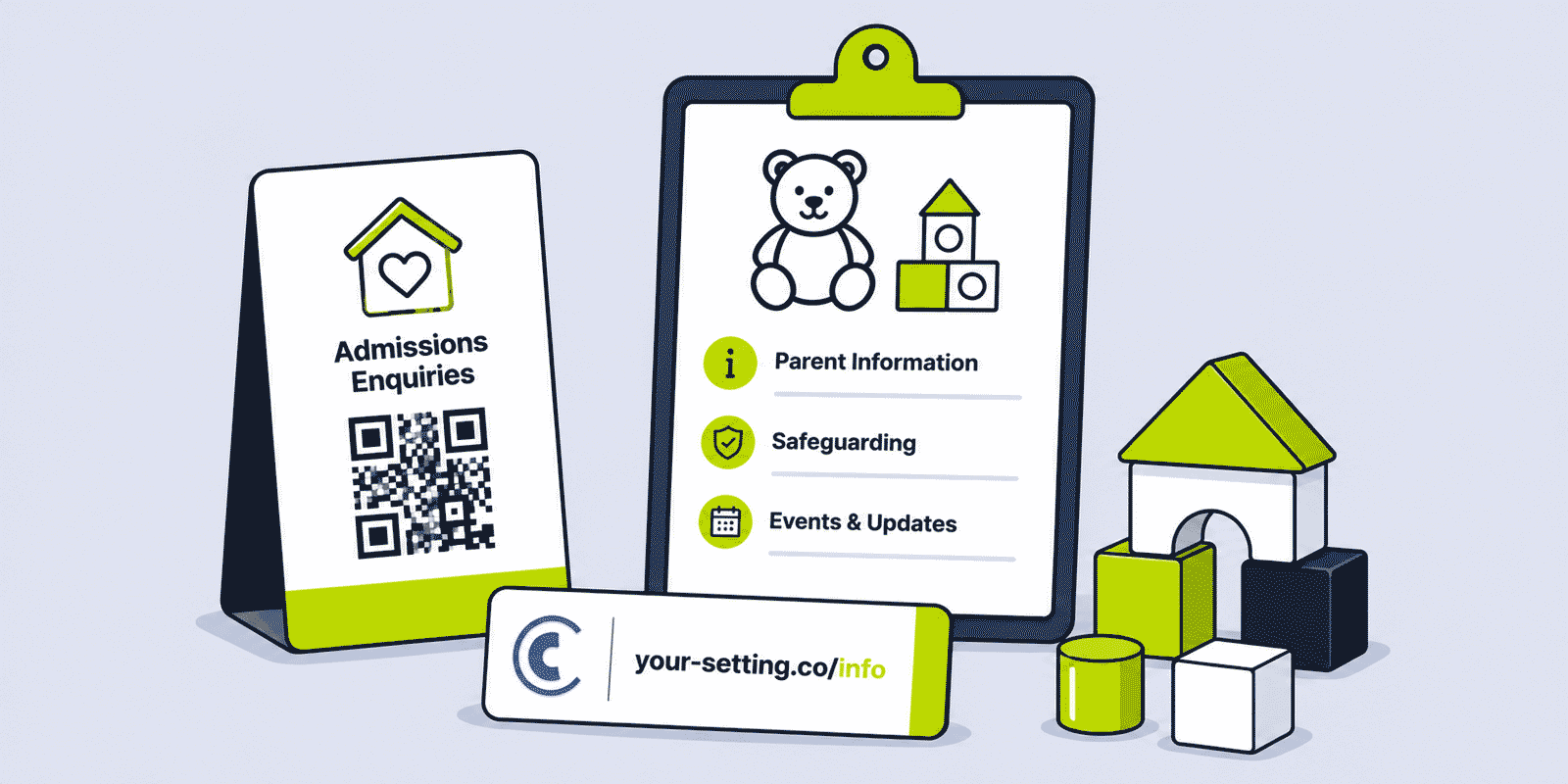
What This Guide Covers
- Why trust and professional presentation are the primary arguments in childcare
- Admissions enquiries: the highest-value short link destination
- Open days and taster sessions: promoted with Action Pages and per-event tracking
- Parent handbook and policy document distribution
- Safeguarding considerations for digital links and QR Codes in childcare
- Reception and entrance lobby QR Code displays
- Community presence: children's centres, local groups, and health visitor networks
- Social media: Instagram, Facebook, and local community groups
- Parent surveys and feedback collection
- Staff recruitment and CPD resources
- Ofsted inspection readiness and documentation links
- Nursery group and multi-setting management
- Google Reviews and local reputation building
- Link in Bio for nursery social media profiles
- Which Cuttly plan is right for a childcare setting
Why Trust and Professional Presentation Are the Primary Arguments in Childcare
Parents choosing a childcare setting go through a research and assessment process that is qualitatively different from almost any other service purchase. The stakes are immediate, personal, and deeply emotional. A parent researching nurseries is simultaneously assessing regulatory compliance (Ofsted grade, DBS checks, staff ratios, safeguarding policies), physical safety and wellbeing (the physical environment, outdoor space, hygiene), educational approach (the setting's ethos, EYFS delivery, activities), and interpersonal fit (whether the staff feel warm, engaged, and trustworthy). This is a holistic assessment that takes place across multiple touchpoints — the setting's website, its social media presence, the physical visit, the welcome pack, and every piece of communication the parent receives before and after registering their child.
Digital links appear at multiple points in this assessment. The link to the admissions enquiry form on a community leaflet. The link in the welcome email following an open day visit. The link to the parent handbook in the onboarding communication. The link to the monthly newsletter. Each of these links is a small but real signal of the setting's quality and care. A branded short link — go.nurseryname.com/admissions or links.settingname.co.uk/handbook — on the setting's own domain signals the same intentionality as a well-organised environment and clearly displayed documentation. A raw Google Docs URL or a generic platform link in the same communication is technically functional but subtly inconsistent with a setting that presents itself as operating to a high standard.
This is the primary argument for branded short links in childcare: consistent professional presentation across every digital touchpoint, aligned with the physical and interpersonal quality the setting delivers.
Admissions Enquiries: The Highest-Value Short Link
For most nurseries and childcare settings, the primary operational priority at any given time is maintaining a healthy admissions pipeline — enough enquiries and visits to keep places filled, waiting lists active, and the setting financially sustainable. The link to the admissions enquiry form or the "register interest" page is therefore the most commercially important link the setting manages.
Create a clean, branded short link: go.nurseryname.com/admissions or links.nursery.co.uk/enquire. This link belongs on every physical and digital touchpoint: the setting's website homepage (most prominent CTA), the Google Business Profile, the Facebook page, the Instagram bio (via Link in Bio), the leaflet distributed at children's centres and health visitor offices, the community noticeboard card, the business card the setting manager carries to parent-facing networking events, and the footer of every email communication to prospective parents.
Create a separate short link per channel — all pointing to the same admissions form. One for the children's centre leaflet, one for the health visitor network referral card, one for the Facebook page, one for the Google Business Profile, one for the Instagram bio, one for the community noticeboard. Monthly link analytics comparison shows which channel generates the most admissions enquiry intent. Over an academic year, this data reveals whether the setting's enquiries are predominantly coming from digital discovery (Google, social media) or physical community presence (children's centres, health visitor recommendations) — intelligence that directly informs where to invest marketing time and any budget.
UTM parameters (Cuttly's built-in UTM builder, all plans including free) pass source attribution through to the setting's website analytics or admissions platform. utm_source=facebook, utm_medium=social, utm_campaign=september-intake-2026 on the Facebook link means the admissions platform shows not just how many people clicked the admissions link from Facebook but how many completed the enquiry form — the full conversion funnel from channel to submitted enquiry.
Open Days and Taster Sessions: Action Pages and Per-Event Tracking
Open days and taster sessions are the primary conversion mechanism in nursery admissions — a family who visits the setting and meets the staff is dramatically more likely to enrol than one who only reviews the website. Promoting these events effectively and tracking which promotional channels drive the most attendance are therefore high-value activities.
Cuttly's Action Pages (Single plan+) provide a lightweight landing page for open day promotion without requiring a website update: setting name and tagline, event date and time, what visitors will experience, who to bring, whether places are limited (and how many remain), a countdown timer to the event date, and a "Reserve Your Place" CTA button. Accessible via a branded short link — go.nurseryname.com/open-day-sept — shareable in all channels, with analytics tracking both page visits and reservation button click-through rate.
Create a unique short link per open day event. If the setting runs three open days per intake cycle, each has its own link: go.nurseryname.com/openday-sept-12, go.nurseryname.com/openday-sept-26, go.nurseryname.com/openday-oct-10. Analytics show which date's promotion generates the most interest — useful for scheduling open days at the most engagement-friendly times in future intake cycles.
For each open day, also create a separate short link per promotional channel. The Facebook post link, the children's centre leaflet QR Code, the WhatsApp message to prospective parent enquirers, and the email to the waiting list each get their own tracked link to the same open day registration page. Post-event analytics show which channel drove the most attendees — data that informs the promotional mix for the next open day.
After each open day, the Action Page or short link destination is updated to redirect to a "Thank you for visiting — next steps" page or to the main admissions page. Parents who click the link after the event (perhaps having found it on a leaflet weeks later) land on appropriate content rather than an outdated event registration form.
Parent Handbook and Policy Document Distribution
Every registered child's family receives a comprehensive set of documents — parent handbook, safeguarding policy, settling-in policy, medication policy, food and allergy policy, complaints procedure, and any relevant statutory policies specific to the setting's registration type and inspection framework. Historically distributed as a physical folder, these documents are increasingly shared digitally — both to reduce printing costs and to ensure parents always have access to the most current version.
A branded short link to each key document — go.nurseryname.com/handbook, go.nurseryname.com/safeguarding-policy, go.nurseryname.com/allergy-policy — replaces whatever raw URL the document hosting system generates (Google Drive, a parent portal, a nursery management system like Famly, Tapestry, or Nursery Management Software). The short link is stable regardless of what hosting system the setting uses or changes to — if the setting migrates from Google Drive to a new nursery management platform, the short link destination is updated in Cuttly and every printed or previously shared link continues to work.
Since childcare policies are reviewed and updated regularly — annually at minimum, and more frequently when regulatory changes occur — the dynamic nature of Cuttly short links is operationally important here. A parent who bookmarked the safeguarding policy link receives the current, reviewed version when they access it. A printed welcome pack that includes QR Codes for key policy documents can be reprinted infrequently and remain current because the QR Codes link to Cuttly short links whose destinations are updated as policies are reviewed.
For documents that contain sensitive information — a parent communication that includes setting-specific child transition data, a document that should only be accessible to registered families — Cuttly's password-protected links (Single plan+) allow the short link to require a password before the destination is revealed. This creates a lightweight access control layer for sensitive documents without requiring a full parent portal implementation.
Safeguarding Considerations for Digital Links in Childcare
Safeguarding is the most important non-negotiable dimension of any childcare setting's operation, and it applies to digital communications as well as physical practice. When using short links and QR Codes in a childcare context, the following safeguarding considerations are relevant — and settings should ensure their use of these tools is consistent with their data protection policy, their designated safeguarding lead's guidance, and any applicable regulatory framework (GDPR in the UK and EU, FERPA in the US, or equivalent in the relevant jurisdiction).
Use branded links that parents recognise. When parents receive a link in a communication from the setting, the domain should be recognisable as the setting's own. A branded short link on the setting's domain — go.nurseryname.com/... — passes this recognition test. A generic short link from a platform-owned domain (cutt.ly/aBcDeF) does not. In a sector where parents are (rightly) cautious about clicking unfamiliar links in messages that claim to be from their child's setting, branded links reduce this friction and the risk of parents dismissing legitimate communications as potential phishing.
Never share links that include identifiable child information in a publicly accessible format. Short links to documents, forms, or pages that contain personally identifiable information about specific children should be password-protected (available from Cuttly's Single plan) or delivered through an authenticated parent portal rather than as a general short link. A link to a generic settling-in guide is appropriate to share publicly; a link to a specific child's developmental journal or care plan is not.
Analytics are aggregated and anonymised. Cuttly's link analytics do not identify individual users who click a link — they provide aggregated, anonymised data on click volume, device type, geographic location, and referrer source. No personally identifiable information about parents or children is accessible through Cuttly's analytics. This is consistent with GDPR requirements for data minimisation in analytics contexts. Settings should note this in any internal data protection documentation that references the tools they use.
Staff-facing resource links. Short links to staff training resources, DBS guidance, safeguarding training, and HR documents shared with the team via internal communications should use links appropriate for the audience — staff communications can use different links from parent-facing ones, and Cuttly's tagging allows these to be clearly distinguished in the analytics dashboard.
Reception and Entrance Lobby QR Code Displays
The reception area and entrance lobby of a nursery or preschool is the first physical space that prospective parents encounter during a visit, and the ongoing daily transition space for registered families. QR Code displays in this space serve both audiences effectively.
For prospective parents visiting for an open day or informal look around, a QR Code display linking to the admissions enquiry form or the current inspection report creates an immediate action path from the visit to the next step. A card that says "Interested in a place for your child? Scan to register your interest or read our latest Ofsted report" with a QR Code is a professional, frictionless call to action that captures interest at the moment of highest engagement — the visit itself.
For registered families in the daily drop-off and collection routine, entrance lobby QR Codes link to: the current monthly newsletter, the setting's parent survey, the upcoming events calendar, or relevant seasonal health information (during flu season, a QR Code linking to the setting's illness and exclusion policy is a practical parent communication tool). Analytics show which lobby QR Codes are being actively used — a code that generates consistent daily scans is working; one that generates no scans may need a more prominent call to action or a different destination.
All lobby and entrance QR Codes must be dynamic — generated from Cuttly short links — so that the destination can be changed seasonally without reprinting the physical display. A lobby card with a "Read our latest newsletter" QR Code that is dynamically linked can point to each month's newsletter as it is published, without reprinting the card.
Community Presence: Children's Centres, Health Visitors, and Local Networks
For most nurseries and preschools, community-based referral networks are the most valuable admissions source: health visitors who recommend settings to families during developmental reviews, children's centres that display leaflets and recommend local provision, GP practices with family health resources, and community groups for parents of young children. Each of these networks represents a potential referral channel — and like all referral channels, their productivity is invisible without tracked links.
The practical implementation: create a unique QR Code short link per community placement. The health visitor network leaflet gets a different short link from the children's centre display card, which gets a different link from the local Mumsnet or Facebook group post, which gets a different link from the church or community hall noticeboard. All route to the same admissions page. Each generates its own analytics.
After three to six months of distribution, the per-source analytics reveal which community placements are generating engagement. A children's centre that generates 12 admissions link scans per month is actively referring; one that generates 2 scans despite having the setting's materials on display may need a relationship conversation with the centre manager or a redesigned leaflet. The scan data makes these conversations evidence-based rather than impressionistic.
Health visitor networks are worth specific mention. A health visitor who hands a family a nursery referral card during a 9-month or 12-month developmental review is making a trusted, professional recommendation to parents who are actively thinking about childcare for the first time. The referral card must be professionally produced, and the QR Code on it — linking to the setting's profile and admissions page — must work reliably. If the setting has changed its website URL or admissions system since the cards were printed, a dynamic Cuttly short link ensures the card still works.
Social Media: Instagram, Facebook, and Local Community Groups
Social media plays a dual role for childcare settings: it builds awareness among local parents who are beginning to think about childcare, and it reinforces the setting's quality and warmth to existing families who follow the page. Instagram content — activity photographs (following the setting's photography policy and appropriate consent procedures), seasonal craft projects, outdoor play documentation, and staff team features — creates a warm, authentic impression of the setting's daily provision.
Every social media profile that includes a call to action — "Find out about joining our nursery," "Book your open day visit," "Download our prospectus" — should use a Link in Bio page behind the single bio link. A Cuttly Link in Bio page at cutt.bio/nurseryname or on the setting's branded domain (Single plan) aggregates: the admissions enquiry form (most prominent button), the upcoming open day registration, the inspection report, the monthly newsletter, the setting's website, and the current parent survey. Analytics on the Link in Bio page show which buttons social media visitors click most — indicating what the local parent audience is most actively looking for.
Facebook community groups — local parents groups, mumsnet local, neighbourhood groups — are often where parents ask for nursery recommendations. Having a short link to the setting's admissions page readily available to share in these group threads (rather than having to navigate to the website and copy a long URL) makes the setting faster and more professional in its response to organic recommendation requests.
Instagram Stories that promote open day dates, share seasonal activities, or highlight the setting's Ofsted rating should use a Story link sticker pointing to a tracked short link — separate from the bio link — so that Story-driven admissions interest is measurable independently from bio link traffic.
Parent Surveys and Feedback Collection
Parent feedback is a regulatory expectation in early years provision in most markets — Ofsted in England, the Care Inspectorate in Scotland, the Care Inspectorate Wales, and equivalent regulatory bodies in other jurisdictions all assess how settings gather and respond to parent views. A documented approach to parent feedback collection, with evidence of how feedback has informed practice, is a quality indicator in inspection frameworks.
Cuttly's native survey builder (all plans including free) creates structured parent surveys distributed via a branded short link — accessible from the entrance lobby QR Code, from the monthly newsletter, or from a specific parent email. The survey questions can cover: overall satisfaction with the setting, specific aspects of provision (activities, communication, settling-in support), and open-ended feedback on what the setting could do better.
Survey responses are encrypted with 256-bit encryption for open-answer fields and exportable in PDF, XLS, and CSV formats. For settings preparing for an Ofsted inspection or similar regulatory review, exportable parent survey data — showing what parents value and how the setting has responded to feedback — is a practical piece of inspection evidence. The survey short link in a newsletter with a cover line of "We value your feedback — this takes 2 minutes" has a typical completion rate significantly higher than a paper survey sent home in a child's bag.
Analytics on the survey link show how many parents clicked through versus how many completed the survey — revealing the friction in the submission process. A 50% click-to-completion rate is typical for a 5-question survey; if completion rates are below 30%, the survey may be too long or the questions may be too sensitive for the channel in which it is shared.
Staff Recruitment and CPD Resources
Childcare settings face persistent recruitment challenges in many markets — qualified early years practitioners are in demand, and the gap between available positions and qualified candidates has been a sector concern for years. Digital recruitment marketing — a Facebook post promoting a practitioner vacancy, a link shared in local early years professional networks, a card posted on local college notice boards for childcare students — benefits from tracked short links in exactly the same way as admissions marketing.
A branded short link to the current vacancies page — go.nurseryname.com/jobs — shared across: the setting's Facebook and Instagram pages, local early years Facebook groups, university and college childcare department notice boards, and the lobby display for parents who may know people looking for positions. Create per-channel tracked links for recruitment just as for admissions — the children's centre notice board vacancy card gets a different link from the college notice board card, which gets a different link from the Facebook post. Analytics show which recruitment channels generate the most interest from qualified candidates.
For continuing professional development (CPD) resources shared with staff — training video links, safeguarding refresher modules, EYFS updates, webinar recordings from local CPD providers — branded short links in the setting's internal communications (team WhatsApp, email, staff area notice board QR Code) present professionally and ensure that if the resource URL changes (a new CPD platform, a refreshed training module), staff can be directed to the updated version without resending the link.
Ofsted Inspection Readiness and Documentation Links
In the UK, Ofsted inspection preparedness involves having documentation readily accessible, demonstrating that policies are communicated effectively to parents and staff, and being able to show evidence of parent engagement and feedback. While a URL shortener is not an inspection tool per se, a well-organised digital document infrastructure — where key policies, handbooks, and parent communication resources are accessible via stable, professional branded short links — is one small but visible element of operational organisation.
Specifically: a setting that can demonstrate to an inspector that parents are directed to a professional, branded link for the safeguarding policy (rather than a raw Google Docs URL or a generic platform link) is showing the same attention to professional presentation that characterises high-quality provision. The Ofsted framework assesses leadership and management quality — how the setting communicates, what systems it has for ensuring parents have access to key information, and how effectively it uses resources to support its operation. Well-organised digital communications are a part of this picture.
Practically: ensure that every policy document linked in parent communications is behind a stable branded short link that is documented in the setting's digital communications log. If the policy URL changes following an annual review and upload, update the Cuttly short link — and note the update in the communications log. This creates an auditable trail of where policies have been shared and how parents have been directed to current versions.
Nursery Group and Multi-Setting Management
Nursery groups operating multiple settings face a specific link management challenge: each setting needs its own admissions links, its own event promotion links, and its own parent communication links — but the group needs consistent brand presentation across all settings and aggregated visibility into admissions performance across the portfolio.
Cuttly's Team plan ($99/month) provides a shared workspace where all settings in the group create links under the group's branded domain infrastructure and shared QR Code style presets. Each setting's links are tagged with the setting identifier — setting-cambridge-road, setting-park-lane — and the group management can view aggregated analytics across all settings in the Campaigns dashboard, or filter by setting tag to see individual setting performance.
For a group running a September intake campaign across six settings simultaneously — social media posts, leaflets at local children's centres, emails to the waiting lists — Cuttly Campaigns (Team plan+) aggregates all campaign links by tag and shows total campaign performance (total admissions enquiry link clicks, device breakdown, geographic distribution, time patterns) in a single analytics view without requiring each setting to export and manually sum its individual data.
Google Reviews and Local Reputation Building
A Google Business Profile for a nursery with 80+ reviews and a 4.9 rating is visible in "nurseries near me" and "childcare [location]" searches before any website content. For parents beginning their nursery search with a local Google query — a very common starting point — this review visibility is the setting's most accessible quality signal. Building a strong review profile is one of the highest-ROI marketing activities for a setting with good provision and satisfied parent community.
A branded short link to the Google Review submission page — go.nurseryname.com/review — should appear in: the annual parent satisfaction email (alongside the survey link), the end-of-year communication to families of children transitioning to school (the highest-satisfaction moment), and in the entrance lobby QR Code display as a "Share your experience" prompt. Each placement gets its own tagged short link for analytics.
The framing matters in childcare more than in most sectors. A parent asked to leave a Google review immediately after a settling-in difficulty may leave a neutral or negative review; a parent asked during a period of positive engagement — a well-managed first term, a positive parents evening, a successful sports day — is far more likely to articulate what makes the setting special. Timing the review request to align with high-satisfaction moments is both good practice and good analytics hygiene.
Which Cuttly Plan Is Right for a Childcare Setting
The Free plan ($0) provides 30 links/month, 1 branded domain, basic QR Code generation, UTM builder, Cuttly Surveys, and 30 days of analytics. No credit card required. For a small childminding business or a very small preschool with minimal active link management, the free plan covers the core use case: an admissions link, a few community placement QR Codes, and a parent survey link. 30 links/month is limiting for active admissions campaigns but adequate for steady-state operation.
The Single plan ($25/month) is the right plan for most registered nurseries, preschools, and early years settings with active admissions marketing and regular parent communications. 5,000 links/month for full campaign activity. Up to 5 branded domains for group settings with multiple brands. 1 year of analytics history — critical for comparing September intake campaign performance year-over-year and tracking which channels generate consistent admissions interest across multiple intake cycles. Full QR customization with SVG export for professional printed materials. Password-protected links for sensitive policy and parent-specific documents. Action Pages for open day and event promotion. Cuttly Surveys for parent feedback collection. Link in Bio for social media profiles.
The Team plan ($99/month) is appropriate for nursery groups with two or more settings, any setting running coordinated multi-channel campaigns with campaign-level analytics needs, and settings integrating short link creation with nursery management systems via the Team API. Shared workspace, Cuttly Campaigns for aggregated group analytics, 2 years of analytics history, and unlimited surveys with custom domain support.
Start with Cuttly's free plan — no credit card required, 1 branded domain included. Create your admissions short link, generate your entrance lobby QR Code, and set up your parent survey in under 30 minutes. Registration required; free plan available immediately.
The New Parent Onboarding Journey and Digital Touchpoints
The period between a family accepting a place at the setting and their child's first session is one of the most anxiety-laden moments in the early childcare experience. Parents are managing competing emotions — relief at securing a place, anxiety about separation, uncertainty about what to expect. The quality of the setting's communications during this period directly shapes the parent's confidence going into the settling-in process.
A well-designed digital onboarding journey uses short links to deliver the right information at the right moment. The welcome email following place acceptance: a short link to the parent handbook for first reading. A week later, a short link to the settling-in guide with specific information about what to expect in the first few sessions. The week before the start date, a short link to a "Getting Ready" resource — what to bring, what to label, what the daily routine looks like. Each link is tracked: analytics show which resources are accessed most actively during the pre-start period, indicating which information parents most need.
For settings that use a nursery management platform like Famly, Tapestry, or similar — which generates parent-facing URLs for the app download, the parent portal login, and any digital documentation — branded short links wrapping these platform URLs present the technology consistently within the setting's brand rather than exposing the underlying platform. A parent who receives a link to go.nurseryname.com/parent-app rather than a raw platform URL experiences a smoother, more professionally cohesive onboarding.
The pre-start home visit — conducted by many settings to help children and families feel familiar with a key person before formal sessions begin — can include a physical card with a QR Code linking to a short video introduction from the child's key person, a virtual tour of the room the child will be in, or a simple "welcome to our nursery family" page. This small gesture, enabled by a QR Code on a printed card, creates a memorable, warm first impression that very few competitors deliver.
Seasonal Campaigns: Intake Registration, Holiday Clubs, and Wrap-Around Care
Nurseries and early years settings have a seasonal rhythm that creates distinct marketing campaigns at predictable points in the year. September intake campaigns (the largest annual admissions period in most markets), January intake (secondary cohort), holiday clubs (Easter, summer, half-term), and wrap-around care expansion all require targeted promotion at specific times, directed at specific audiences.
Each seasonal campaign benefits from its own set of tracked short links — allowing post-campaign analysis of what worked. A summer holiday club campaign that runs across Facebook, local Facebook parents groups, a community leaflet in local primary schools, and an email to the existing parent community generates five short links (one per channel) all routing to the same holiday club registration form. When the campaign closes, analytics show total registrations (from the form) and per-channel engagement (from Cuttly) — the complete campaign attribution picture.
Cuttly's link expiration by date (Single plan+) is directly useful for seasonal intake campaigns. A September intake registration form that closes on 31 July can have its short link set to expire on that date — after which point, scanning or clicking the link routes to a "September intake is now closed — register your interest for January" message. No manual intervention required when the deadline passes. Parents who find the leaflet or social post after the deadline land on appropriate content rather than an expired or confusing form.
For holiday club promotion specifically: Cuttly's Action Pages (Single plan+) provide a focused holiday club landing page without requiring a full website build. Club name and setting, dates and hours, age groups covered, activities included, cost, limited spaces (if applicable), a countdown timer to the booking deadline, and a "Book a Place" CTA. The Action Page is accessed via a branded short link — go.nurseryname.com/summer-club-2026 — shareable in all promotional channels. Analytics track both page visits and booking click-through rate per campaign cycle.
Measuring Admissions ROI Across Channels Over Time
One of the most underappreciated aspects of running a childcare setting as a business is the admissions marketing ROI question: where do enquiries actually come from, and which activities are worth the time and any spend invested? Most settings have strong intuitions — "most of our families come from word of mouth," "the children's centre leaflet doesn't do much," "Facebook is getting us enquiries" — but intuitions without data are unreliable guides to resource allocation.
A structured link tracking approach across all admissions channels converts these intuitions into data. The setup: at the start of each academic year, create a short link set — one per active admissions channel. Document which link corresponds to which channel. At each major intake cycle (September, January, April), review analytics for each link. At year-end, compile the annual admissions attribution data: which channels generated the most admissions enquiry link traffic over the year.
The data typically reveals one or two genuinely productive channels and several that generate little measurable impact despite ongoing effort. A children's centre placement that generates 2 link clicks per month despite the setting restocking it quarterly is a low-productivity channel. A Facebook community group that generates 18 link clicks per month from a single pinned post is a high-productivity channel. Redirecting the time spent on the low-productivity channel to the high-productivity one is a resource allocation improvement that the data makes obvious and that intuition alone would probably not surface clearly.
Year-over-year comparison (available with 1 year of analytics history on the Single plan, 2 years on Team) reveals whether channels are growing or declining in effectiveness. A channel that generated 15 enquiry clicks in September 2025 and 8 in September 2026 is declining — potentially indicating audience shift, increased competition in that channel, or a need to refresh the materials. A channel that grew from 8 to 23 clicks in the same comparison is worth further investment.
Transition to School: Supporting Families at the End of Their Nursery Journey
The transition to school is a significant milestone for families leaving the nursery, and the setting's management of this transition is both a professional responsibility and a final opportunity to cement the quality of the relationship. Well-managed transitions generate the warmest testimonials and the most enthusiastic referrals — parents who feel supported in this milestone are the most likely to recommend the setting to friends and family members with younger children.
Digital resources for the school transition: a transition guide that covers what to expect in Reception year, tips for supporting children over the summer, and a note from the child's key person about their development and readiness. A short link to this guide — go.nurseryname.com/school-transition-guide — sent in the final week communication creates a lasting resource families keep and refer back to over the summer. Since the guide is linked via a dynamic short link, it can be updated each year for new families without any need to resend the link.
The end-of-nursery communication is also the optimal moment for a Google Review request. A family leaving for school, in the warm glow of a successful nursery experience, is in the best possible frame of mind to write a genuine, enthusiastic review. Include the Google Review short link — go.nurseryname.com/review — in the transition email alongside the transition guide link. The setting that does this consistently, for every cohort of school-transition children, builds its review base steadily and systematically rather than relying on occasional unsolicited reviews.
Frequently Asked Questions
Why do nurseries and childcare settings need a URL shortener?
To create professional branded links on their own domain in every parent communication — essential in a trust-sensitive context where consistent professional presentation matters. Also to track which admissions channels generate the most enquiries, and to make long admissions platform and portal URLs shareable in leaflets, noticeboards, and digital parent communications without being unwieldy.
Are there safeguarding concerns with QR Codes and short links in childcare?
Key practices: use dynamic branded short links so parents recognise the source; never link to identifiable child information through publicly shared links; use password-protected links for sensitive documents; and ensure analytics practices are consistent with GDPR/data protection policy. Cuttly analytics are aggregated and anonymised — no personally identifiable information is collected through link clicks.
How can a nursery use QR Codes?
In the entrance lobby and reception (admissions link, inspection report, monthly newsletter), on welcome packs (parent handbook, key policies), on community leaflets (admissions page, virtual tour), on open day promotional materials, and in monthly newsletters (parent survey). All dynamic — updatable without reprinting physical materials.
Which Cuttly plan is right for a nursery?
Most registered settings start with Single ($25/month): 5,000 links/month, 5 branded domains, 1 year analytics history, full QR customization, password-protected links, Action Pages for open days, surveys for parent feedback, Link in Bio. Free plan (30 links/month) is adequate for minimal use. Nursery groups with multiple settings need Team ($99/month).
- Tools
- URL Shortener →
- Link in Bio Builder →
- QR Code Generator →
- Link Analytics →
- Related Industry Guides
- URL Shortener for Schools →
- URL Shortener for Tutors →
- URL Shortener for Healthcare →
- URL Shortener for Small Business →
- Related Guides
- What Is a Branded Short Link? →
- QR Code Best Practices 2026 →
- Link Tracking 101 →
- UTM Parameters Guide →
- What Is a Dynamic QR Code? →
- Verticals Hub
- URL Shortener for Every Industry →
- Start Here
- Create Free Account
- Plans & Pricing
URL Shortener
Cuttly simplifies link management by offering a user-friendly URL shortener that includes branded short links. Boost your brand’s growth with short, memorable, and engaging links, while seamlessly managing and tracking your links using Cuttly's versatile platform. Generate branded short links, create customizable QR codes, build link-in-bio pages, and run interactive surveys—all in one place.
Cuttly - Consistently Rated
Among Top URL Shorteners
Cuttly isn’t just another URL shortener. Our platform is trusted and recognized by top industry players like G2 and SaaSworthy. We're proud to be consistently rated as a High Performer in URL Shortening and Link Management, ensuring that our users get reliable, innovative, and high-performing tools.


